The devastating impacts of climate change are felt acutely across India. Rising temperatures, an increasingly unpredictable monsoon season, and climate-related threats like malaria pose consequential risks to public health, infrastructure, energy security, and economic well-being.
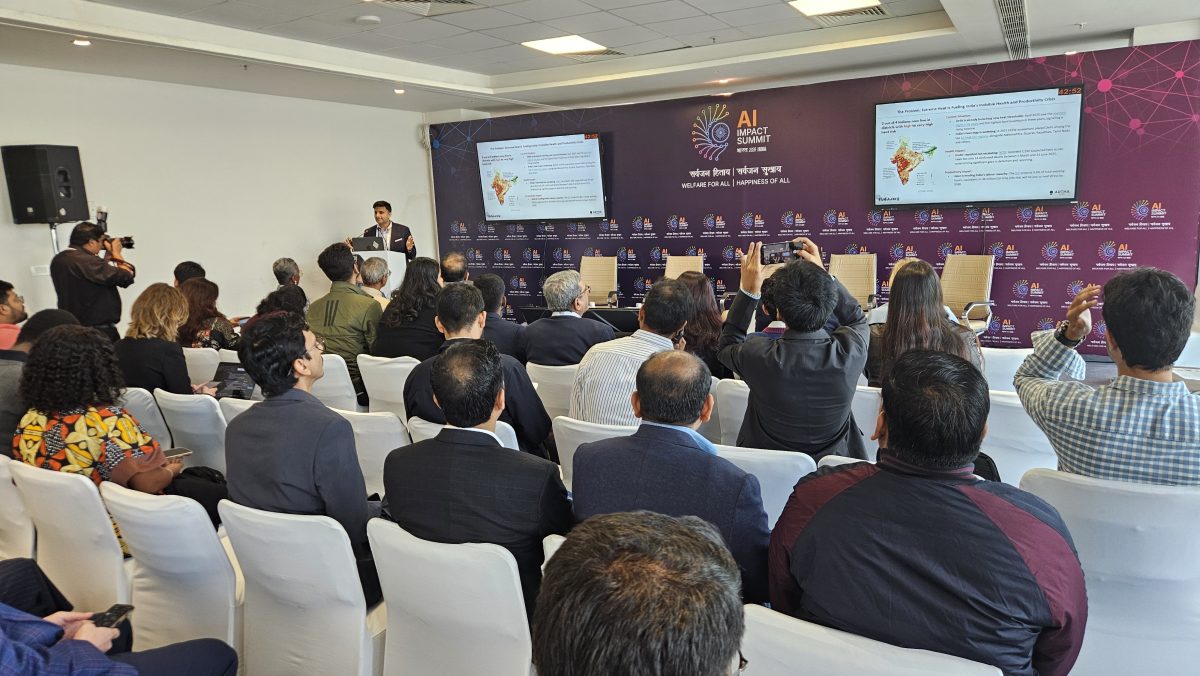
“These domains may appear distinct, but they are fundamentally interconnected,” said Dr. Cormekki Whitley, interim president and CEO of data.org, as she kicked off “Scaling Climate Solutions: Data, AI, and India’s Energy Transformation,” the organization’s second mainstage session at the India AI Impact Summit.
The interconnectedness of these priorities is what drives data.org’s Climateverse initiative through partnerships forged under the Capacity Accelerator Network, and it was reinforced by a panel of experts as Director of Capacity Building, Priyank Hirani, moderated a discussion on how to move from innovations to institutionalization—from isolated data and AI pilots to meaningful systems-level change.
So, what are the enabling conditions required to unlock the power of data and AI and achieve India’s ambitious goal of net-zero emissions by 2070?
- Create a strong, interoperable foundation
“There cannot be a good AI strategy without a good data strategy,” said Srinivas Krishnaswamy, CEO and founder of the Vasudha Foundation. The availability, granularity, quality, and interoperability of data—and consensus on its standards and governance—are essential. Karan Shah, COO of Artha India, and his colleague, Dr. Neelanjan Sircar, director of the Centre for Rapid Insights at Artha Global, provided a compelling example from their own research. Heat action plans, they explained, are typically made at the district or state level, but how heat is experienced and how it affects things like productivity varies significantly at the hyper-local level. Greater standardization and collaboration are necessary to shore up existing data and AI systems and create visualizations and tools that make data actionable for communities. “In India’s power sector, we have a lot of data, but it’s unstructured and not interoperable. We need a regulatory data exchange to unlock its potential,” added Akhilesh Magal, founder of Climate Dot. - Leverage the ecosystem at scale
Panelists emphasized the importance of trust—a pillar of data.org’s work in democratizing data. Swetha Ravi Kumar, executive director of FSR Global, said that trust must be baked into every stage of development and execution. India Energy Stack, where FSR Global is the Secretariat, has sought to do that by inviting all stakeholders across the private sector, civil society, think/do tanks, government, academia, and technology providers to the design table, paving a path for sustained shared ownership. “This is coordination at scale,” she said. “We’re talking about designing systems for billions, so inclusivity is a very important aspect we need to consider.” She described a “triple A framework” to guide the ecosystem: architecture, or common data language; adoption, or the pathways to harness data and AI; and accelerator, the sandbox environment where partnerships flourish, and learnings are freely shared. - Build interdisciplinary capacity
“Nobody should be left behind. A just transition requires reskilling and upskilling the workforce at scale,” said Dr. Srikanta K. Panigrahi, a distinguished research fellow and director general of the Indian Institute of Sustainable Development. Often, organizations that lack internal data and AI capacity assume there is an external procurement fix, but Dr. Priya Donti, assistant professor at MIT and co-founder and chair of Climate Change AI, said a more diverse ecosystem of solution providers and interdisciplinary talent is necessary, both in internal capacity and more specialized providers externally. “It’s incredibly important that we think about AI literacy at a much larger scale in the climate sector,” she said.
These enabling conditions are essential to foster greater organizational AI readiness so that the social sector—as well as governments and other partners—can deploy data and AI tools to drive climate progress.
“Data and tools must be easier to discover, more granular, interoperable, and supported by incentives and infrastructure, and paired with interdisciplinary capacity building and stronger multistakeholder collaboration,” Whitley said.
If India can align its climate ambition, digital public infrastructure, and institutional capacity, it has the opportunity not only to scale Climate × AI domestically—but to offer a model for other emerging economies navigating similar transitions.
Let’s continue building systems—not just solutions.