Educators and entrepreneurs, policymakers and leaders across geography and sector are increasingly arriving at the same conclusion: proficiency in data and AI is the new essential skill for the workforce.
“You would never send firefighters into a burning building without equipment. So, we cannot send social impact organizations into addressing societal challenges without the data and AI capabilities that define this modern era, the era of AI,” said Dr. Uyi Stewart.
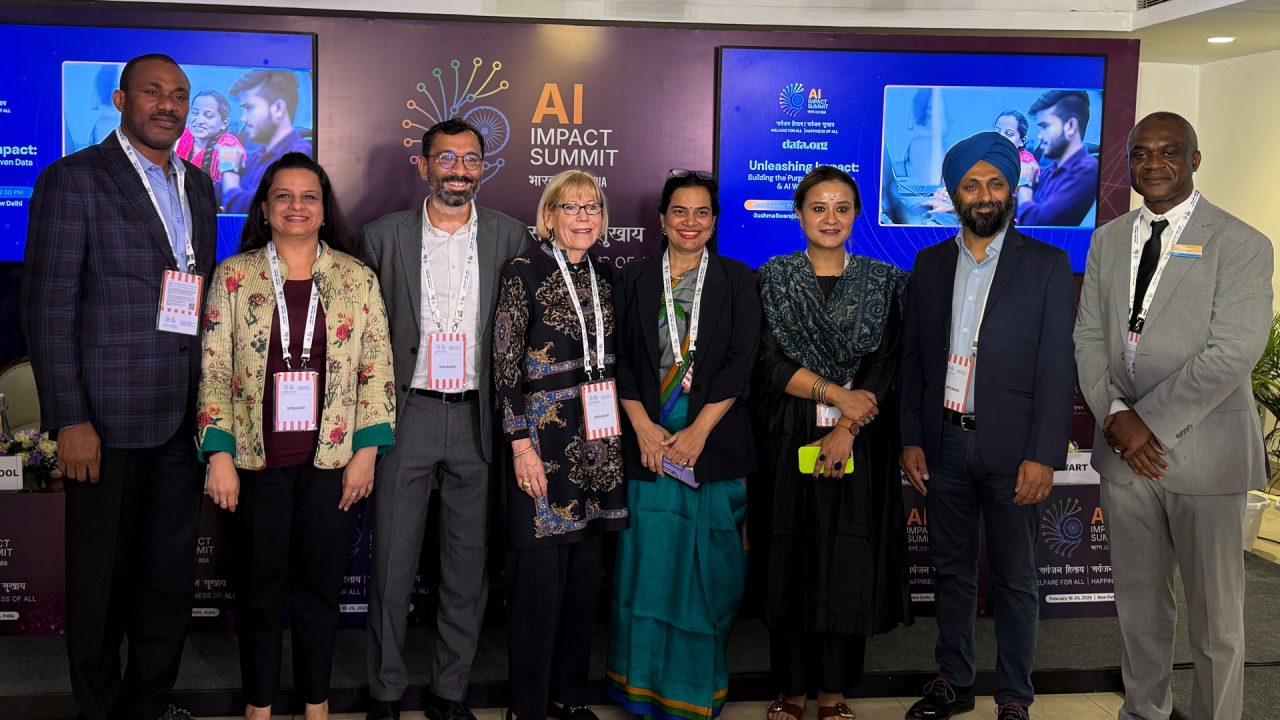
Stewart is the vice president of inclusive innovation and analytics at the Mastercard Center for Inclusive Growth and the former chief data and technology officer at data.org. In their respective opening remarks, Stewart and data.org Director of Capacity Building Priyank Hirani agreed that there is general consensus on the importance of data and AI capacity, but that there is still much work to be done in actualizing an AI-empowered workforce responsibly and sustainably.
Work that cannot wait.
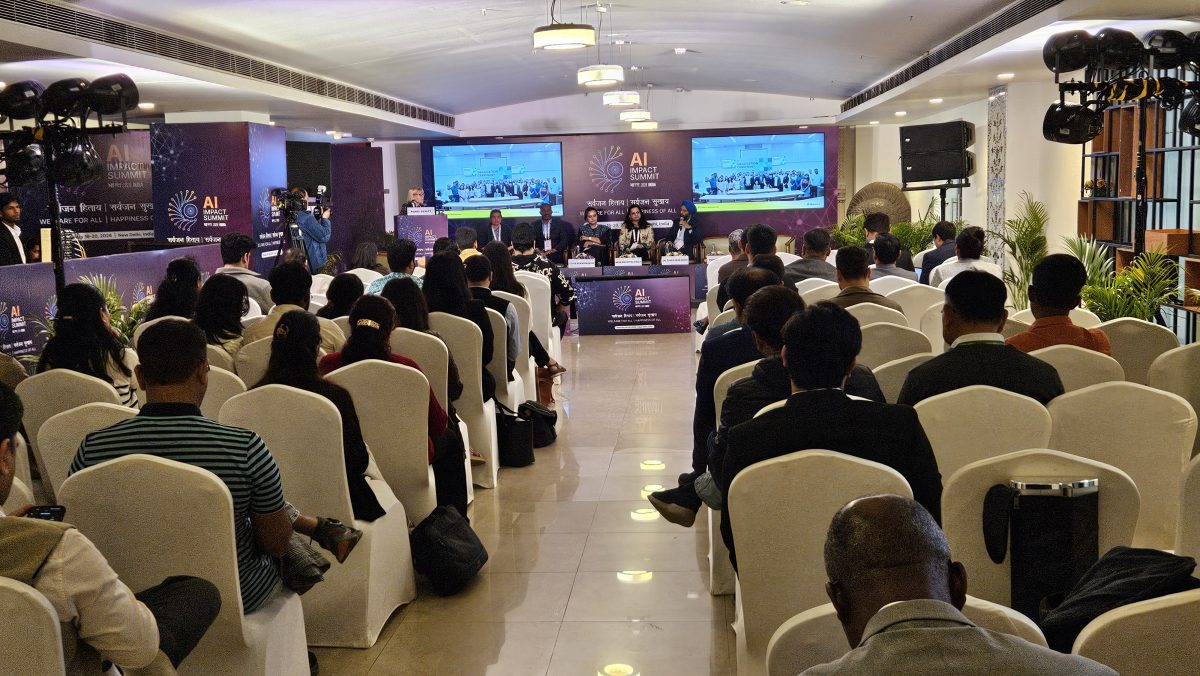
At the AI Impact Summit in New Delhi, India—one of the world’s largest stages for leaders and innovators in artificial intelligence—data.org hosted a session to tackle this looming and urgent issue. In “Unleashing Impact: Building the Purpose-Driven Data & AI Workforce,” five partners from data.org’s Capacity Accelerator Network made the case for an immediate and collaborative global approach anchored in local needs.
Why We CAN
With five hubs across four continents, the Capacity Accelerator Network is building the purpose-driven data and AI workforce that Stewart previewed. In the United States, India, Africa, Latin America, and the Asia Pacific, Accelerators are globally-informed and locally-grounded, bolstered by a growing network of more than 100 cross-sector partners.
data.org launched the first CAN hub in 2022, and quickly realized it was a workforce development pathway worth cultivating. CAN invests in supply—training new practitioners, traditional college students, and existing social sector leaders—as well as demand by providing opportunities for hands-on fellowships, simultaneously building the capacity of social impact organizations to employ professionals long term.
“For us, the fellows are an instrument to create a multiplier effect. One individual works with one organization that has a strong network, then influences that organization to scale these solutions and, in turn, impact millions of lives,” said Tithee Mukhopadhyay, deputy executive director of the Abdul Latif Jameel Poverty Action Lab South Asia (J-PAL SA), a CAN partner at the intersection of research and practice.
Neha Malhotra Singh, associate director of Janaagraha—a host organization for CAN fellows—agreed, saying that CAN collaborations bring an “exponential impact” by pairing deep domain expertise in-house with data and AI skills brought by a CAN fellow.
How We CAN
The COVID-19 pandemic exposed weaknesses and failures of public health infrastructure worldwide. It also created an urgent opportunity for the social sector to collaborate and create new tech, tools, and solutions to serve communities.
Social impact organizations aren’t waiting for the next crisis to work together.
“Create impact in peace times,” said Dr. Tavpritesh Sethi, associate professor of the Indraprastha Institute of Information Technology Delhi (IIIT-Delhi), a CAN academic training partner. “You can’t rely on a pandemic to force solutions.”
Impact is being consistently created through CAN’s various workforce strategies: training, fellowships, experiential learning, digital learning, government partnerships, and deep community engagement. These approaches build on one another in support of growing the network, and today, more than 150,000 people have been AI empowered.
What Comes Next
There are significant challenges to address in the data and AI ecosystem, including expanding large language models in languages other than English and Mandarin.
Ultimately, though, CAN partners said they feel strongly that they can be a key part of developing and sharing data and AI solutions so others can unlock their potential.
“Playbooks catalog how data can be collected so that the knowledge is democratized to help any group of people,” said Olubayo (Bayo) Adekanmbi, CEO of Data Science Nigeria and a co-author of data.org’s low-resource-languages playbook. Adekanmbi emphasized the importance of tools and resources not being translated, but informed by and built with native language inputs of underrepresented communities.
“If language is the fundamental expression of the culture of a people, if it is not digitized in the emerging digital era, it means that a whole essence of a people can be lost,” he said.
When knowledge and opportunities for workforce development are democratized, momentum for data and AI for social impact grows.
“People come alive when they can solve problems and save lives, and the energy in the room changes,” said Pratibha Kurnool, head of social impact for Cognizant in Asia Pacific and Japan. “When we intentionally embed purpose in everything we do, especially AI skilling, we can create positive outcomes.”
data.org Chief Strategy Officer Perry Hewitt, who moderated the panel, shared the optimism—and determination—of the CAN panelists.
“It’s about possibility,” she said. “What’s possible gets more astonishing every single day.”