Balancing Mission and Margin: How Adaapta is Redefining Brownfields Redevelopment Using Community Engagement & Data Science
Download the Case Study
Introduction
Brownfield sites are some of the most difficult real estate challenges in the United States: high risk, high cost, and low community trust. Adaapta is proving that even in this challenging terrain, a mission-first business model can thrive by leveraging community engagement and data science.
Setting the stage
There are brownfield sites across U.S. cities and towns: shuttered factories, abandoned gas stations, and derelict industrial sites that mar the landscape. These properties are more than just eyesores; they pose persistent environmental health risks and stifle local economies. Often located in historically disinvested, low-income, and minority neighborhoods, they represent a legacy of environmental injustice. Traditional developers, wary of uncertain cleanup costs and environmental liabilities, have long steered clear, leaving these parcels to languish, sometimes for decades. And when redevelopment does happen, communities are rarely involved or even consulted.
This creates a paradox: the communities most harmed by these contaminated sites are also the ones with the most to gain from their transformation, yet they are systematically excluded from the redevelopment process. Adaapta, a mission-driven brownfield redevelopment organization, was founded to address this very conflict by putting communities first.
This case study follows two women, Mary Hashem and Danielle Getsinger, who merged their complementary strengths and organizations to tackle the systemic problem of brownfield redevelopment, building a sustainable business while navigating the inherent tension between mission and margin.
The Foundations of a Mission
The story of Adaapta began with two professionals on parallel tracks who saw the same broken system from different angles.
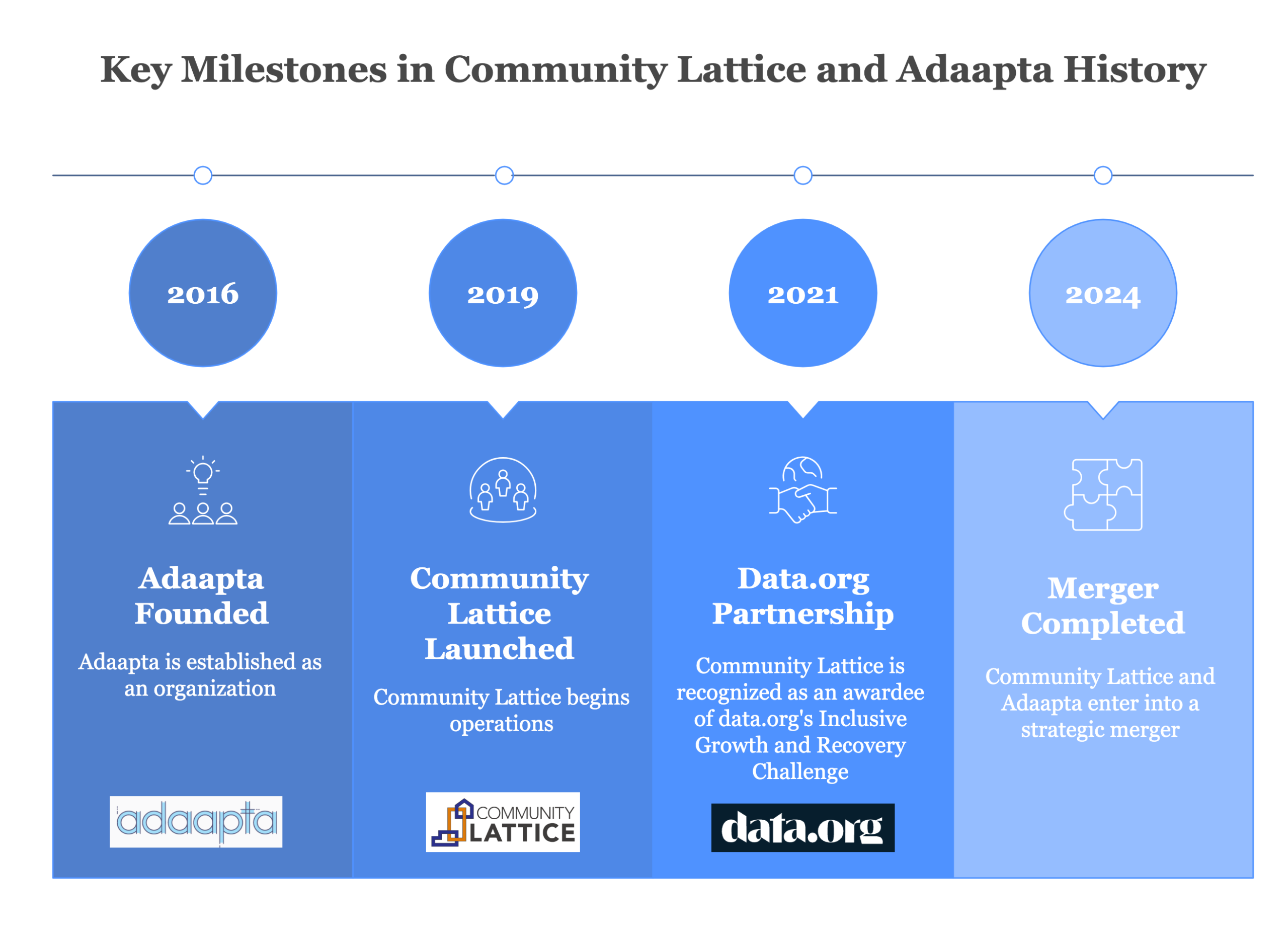
Mary Hashem, an MIT-educated geoscientist, began her career in the early 1990s, joining one of the first companies, The LandBank Group, to specialize in the acquisition and redevelopment of contaminated properties. After more than two decades in the field, she founded Adaapta as a vehicle to share her expertise—offering mentoring, technical assistance, and guidance to a new generation of practitioners just beginning to navigate the complexities of brownfield redevelopment.
Her decision was also informed by what she had witnessed on the ground. Many communities sought revitalization but were unequipped to engage with developers, who were in positions of power. Developers, driven by private capital and tight margins, had little incentive to alter their plans to incorporate or make room for community input. Mary recognized that for communities to truly shape redevelopment, they needed to be involved at the beginning of the process. Adaapta’s mission included equipping communities with knowledge of market dynamics, financial pro formas, and a developer’s perspective, giving them the tools to participate in the redevelopment process.
In 2019, Danielle Getsinger, a professional geologist, left the environmental consulting world to start Community Lattice, responding to the needs of disadvantaged communities through land revitalization and brownfields redevelopment. Her work rested on a simple observation: while residents intimately understood the challenges in their neighborhoods, their lived experiences were often dismissed without quantitative evidence. To successfully compete for federal grants or influence policy discussions, they needed to validate their stories with hard numbers. Danielle set out to close that gap by creating brownfield inventories that enabled data-driven planning for redevelopment.
In 2021, Danielle’s mission was supercharged when Community Lattice was selected as an awardee of data.org’s Inclusive Growth and Recovery Challenge. The data.org Innovation Challenge, funded by the Mastercard Center for Inclusive Growth and The Rockefeller Foundation, called for breakthrough ideas that harness the power of data to help people and communities thrive. With this support, Danielle’s team used machine learning to build two open-source tools that could visualize environmental records and predict both the costs and risks of redevelopment projects: Platform for Exploring Environmental Records (PEER) and the Analysis of Brownfields Costs (ABC). This partnership enabled them to tackle the data problem head-on, transforming a community’s ability to secure redevelopment funding and initiate revitalization efforts.
A Merger of Purpose and Expertise
Mary and Danielle’s companies were orbiting each other as partners, both serving as technical assistance providers for the Kansas State University Technical Assistance to Brownfields (KSU TAB) program. Their shared role brought them together on multiple projects, where they quickly discovered how seamlessly their work complemented each other’s. “Our companies were sort of like puzzle pieces,” Mary recalls. Adaapta had deep expertise in structuring complex real estate deals, financial analysis, and managing environmental risk. Community Lattice possessed cutting-edge data tools, a sophisticated grassroots approach to community engagement, and strong partnerships with local governments, like that with the City of Houston, Texas. Their synergy was immediate and profound, setting the stage for what would become the natural next step.
What began as conversations about partnership quickly evolved into something more. “It became really obvious that we just needed to merge,” Mary says. In 2024, Adaapta formally acquired Community Lattice, uniting both teams under the Adaapta brand to amplify their impact. With Mary as the Founder and President, and Danielle as the CEO of Adaapta, the merger was more than a strategic business decision; it was a fusion of the shared outlook of adding value to communities, not extracting it.
The merger led to the formalization of a succession plan. Mary, looking toward retirement, saw Danielle as a leader who could carry the mission forward. “My role now is really one of mentorship and guiding Danielle…to help her be able to carry Adaapta’s mission forward,” she notes. By aiming to expand capacity and capabilities in service of their shared mission, the merger brought into sharp focus a central challenge for any social impact organization: how to stay commercially viable without compromising on purpose.
Forging a Sustainable, Mission-First Business Model
The newly merged Adaapta was well-positioned to build a business model that could respond to this question. Together, Mary and Danielle shaped a hybrid model that blends the structure of a traditional consulting firm with the soul of a nonprofit. “It’s really not too far off from a classic consulting model,” Danielle explains. “We’re selling our hours…except where the money is coming from and the projects that we’re working on are different.”
Adaapta’s primary revenue stream comes from federal funding, particularly the Environmental Protection Agency’s (EPA) Brownfields grants. They engage in this work through several pathways: sometimes as subcontractors to prime contractors holding direct EPA contracts; other times as partners to communities that have secured grants and need technical support to execute the work. They also take on projects where the EPA itself identifies communities for assistance through its Regionally Directed Technical Assistance program. Many projects also arise through referrals from consultants, attorneys, or state environmental agencies. Beyond federal sources, Adaapta also receives project-based support and grants from foundations, nonprofit organizations, and individual donors. A smaller portion of their revenue comes from private developers.
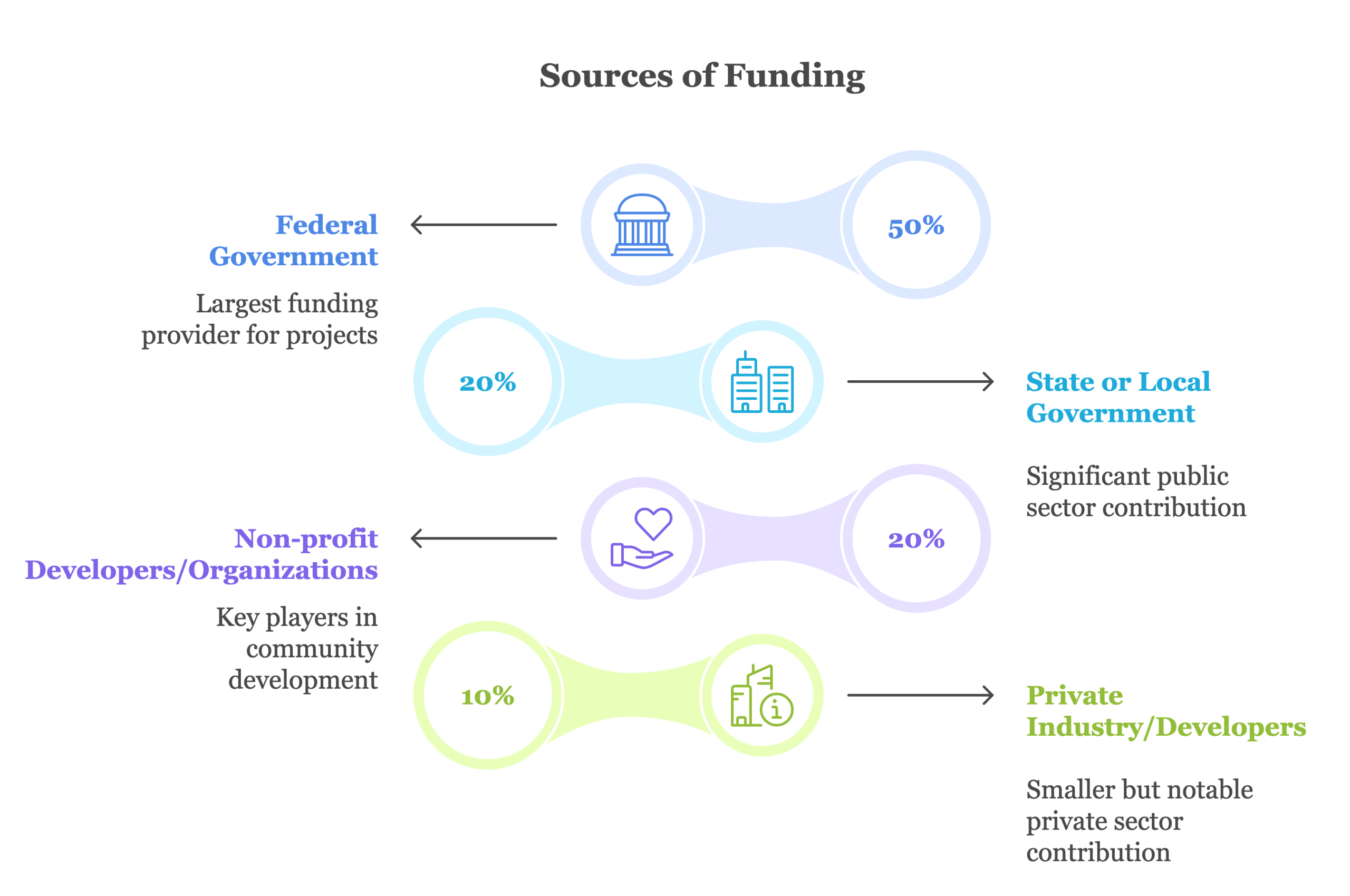
The kinds of funding Adaapta pursues reflect the impact it aims to create. Its core client focus is municipalities, nonprofits, and community-based organizations that often lack the technical and financial capacity to navigate complex redevelopment projects. As Mary notes, the organization was “very intentionally designed to help the nonprofit [and] public sector[s].” By serving where most developers and consultants won’t, Adaapta has carved out a market niche that aligns its revenue model with its mission to empower communities.
But what truly sets them apart is their business development strategy, which is indistinguishable from their social impact work. Instead of slick marketing pitches, their investment is time spent on the ground. As Danielle notes, “We’re not going out there and saying, ‘Hey, you guys need to hire us because we’re amazing.’ We’re investing our time and resources in being there for communities by finding projects and helping them move forward.” This often means showing up to community meetings, providing pro-bono advice, and helping local leaders identify grant opportunities long before a contract is signed. This approach enables them to build the deep trust that is the currency of their work.
This upfront investment in relationships has become Adaapta’s competitive advantage. When communities secure the grants or other financing needed to fund larger projects, they return to Adaapta for implementation support, creating a self-reinforcing pipeline of work.
Danielle likens their approach to rock climbing: they begin knowing the summit is within reach, even if they don’t yet see every hold. Along the way, they secure anchors—a small grant here, a city contract there—that keep them moving forward. The analogy reflects Adaapta’s entrepreneurial mindset and bias toward action, but in a way that always serves the mission. “We’re not just saying yes to anything,” she clarifies. “We’re saying yes to the work that we’re passionate about…where there’s a clear impact and mission alignment.”
That discipline comes with trade-offs. Operating in a mission-first model means turning down projects that could deliver quick capital but lack real community impact. While it limits certain revenue opportunities, it ensures that Adaapta’s growth remains consistent with its brand and mission.
Redefining Success
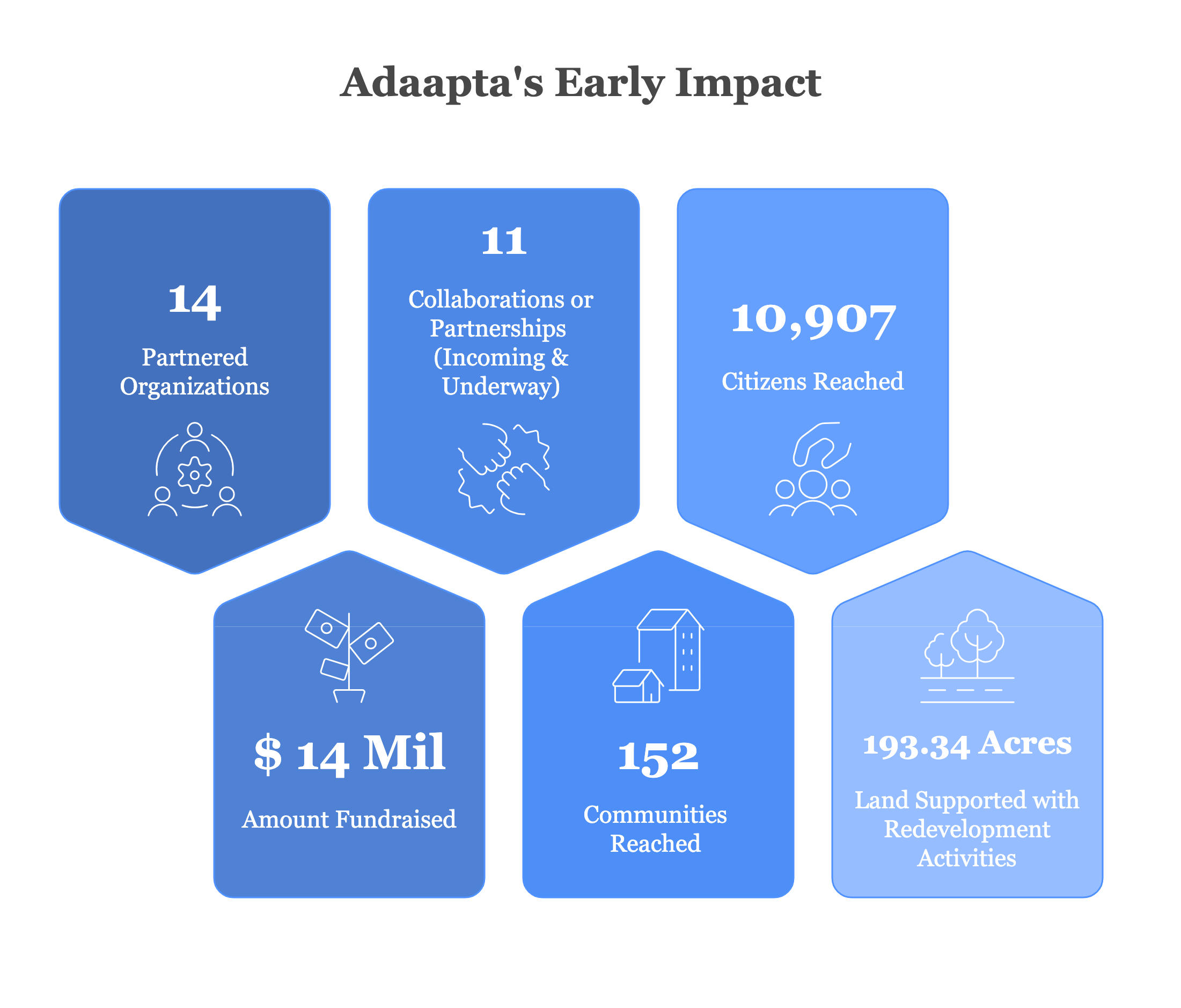
Adaapta is redefining how success is measured. Danielle explains, “We’re changing how we measure success from the conventional way of how much profit was made to how much land is now in community hands or how many jobs have been created for local residents.” By putting impact metrics at the center, Adaapta ensures every decision reinforces the mission. The tangible results of this philosophy are striking. Adaapta has partnered with 14 organizations to help 152 communities, reaching over 10,000 citizens. Their work has supported the redevelopment of over 193 acres of land in the past year alone, and helped fundraise more than $14 million for community-led projects.
The Model in Action: Data, Trust, and Transformation
Nowhere is Adaapta’s model more evident than in its work with communities. The team understands that a significant barrier to redevelopment is not contamination, but distrust. “There’s generational distrust,” Danielle says, citing historical trauma from projects like highways that tore through minority neighborhoods. “It’s the distrust of the government. It’s the distrust of developers. It is the distrust of the data.”
Adaapta uses data as a neutralizer to rebuild that trust. They don’t just present data; they co-create it with the community. Their core function is empowering communities to tell their own, more powerful stories. As Danielle explains, residents don’t need a statistical report to know their challenges because they experience them daily. Adaapta’s role is to provide the quantitative data that validates this lived experience, weaving hard data into the community’s own narrative to transform anecdotal evidence into a compelling story that grant reviewers and policymakers can’t ignore.
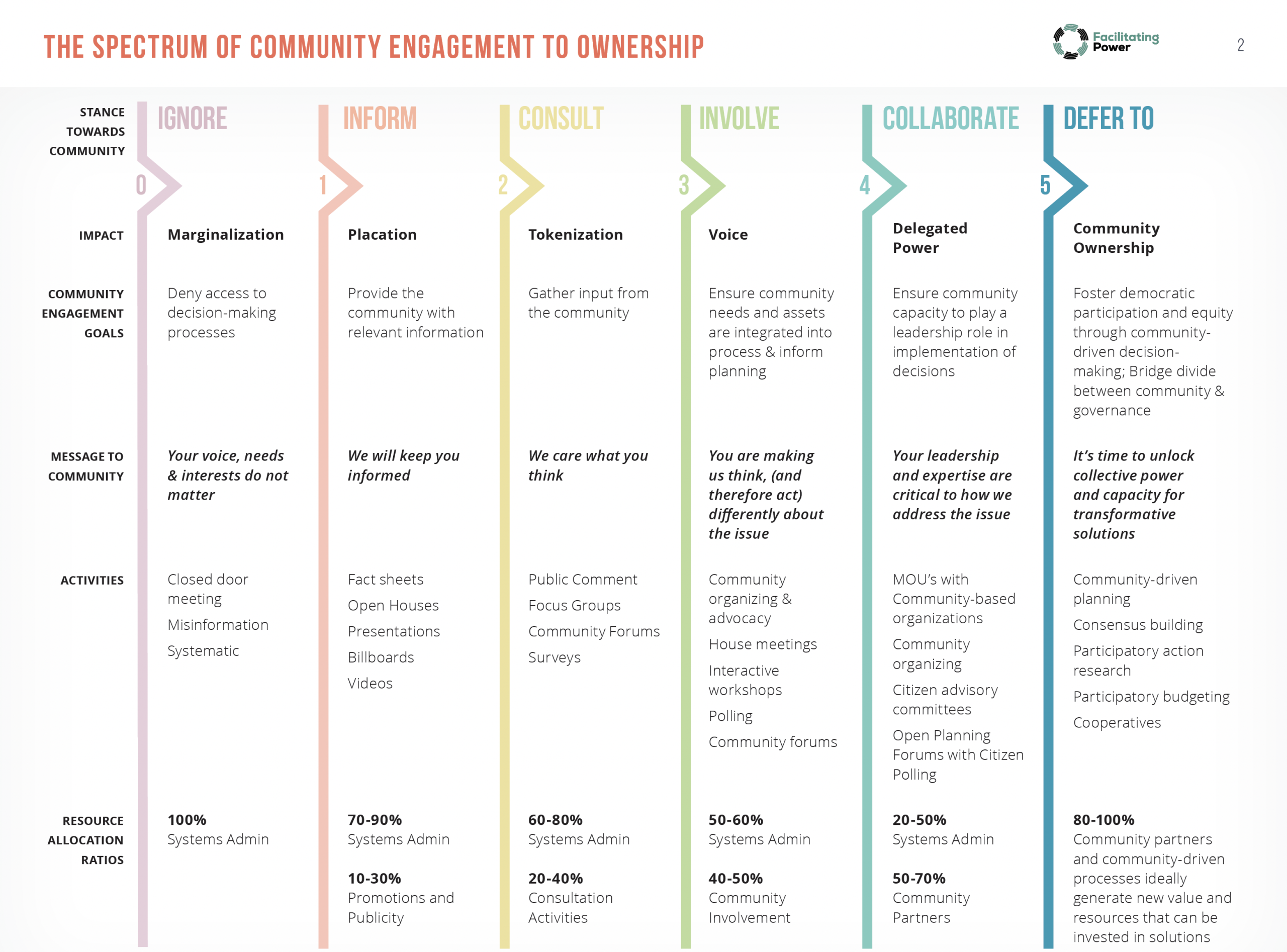
Their entire approach is informed by frameworks like Rosa Gonzales’ Spectrum of Community Engagement to Ownership, which helps distinguish between tokenistic outreach and genuine, community-driven partnership. Adaapta intentionally operates at the higher end of this spectrum, working toward collaborating with and empowering the community, instead of simply informing them.
This trust-building process has yielded remarkable results in Houston. With Adaapta’s strategic guidance, the Houston Land Bank has secured over $6 million in EPA grants. This funding is transforming sites that had been abandoned for decades. One project is redeveloping the former Yellow Cab taxi headquarters into over 65 units of affordable housing. Another is cleaning up a city incinerator site that had been derelict for 70 years and turning it into parks and open space. As Christa Stoneham, CEO of the Houston Land Bank, observes: “You can tell by their level of engagement and relationship stewardship beyond the project that this is more than just a contract for them.”
The ripple effects extend beyond the Land Bank; the Black United Fund of Texas used Adaapta’s guidance to secure $1.7 million, of which $400,000 has been realized, for a community-led hydroponic farm and workforce training center, a project born from a neighborhood’s vision and made real through data-backed storytelling.
Adaapta’s partnerships also extend beyond individual communities to the federal level, reflecting how its mission-first model operates at scale. As a technical assistance partner with Tetra Tech for EPA’s Brownfields Job Training (BFJT), Adaapta develops practical training resources, facilitates national learning networks, and provides one-on-one support to grantees building local environmental workforces. Through this collaboration, Adaapta helps translate federal investments into sustainable career pathways in communities deeply affected by environmental disinvestment.
The Path Forward: Scaling Impact, Not Just Size
Adaapta’s vision for scaling is as unconventional as its business model. “Scaling for us means expanding our network of partners rather than growing into a large, 300-person company,” Danielle explains. The goal is to maintain a nimble core team and build a broad ecosystem of collaborators to meet the unique needs of each community. A large overhead, she fears, would force them to chase revenue and compromise their mission.
Looking ahead, Adaapta is pursuing multiple levers to advance equitable redevelopment. They are driving land bank legislation, exploring co-development with communities, and collaborating with universities, philanthropies, and data and AI-for-good networks to shape the future of the field. Partnerships with institutions like DataKind, University of Houston, and Rice University’s Sustainability Institute are helping Adaapta push the boundaries of what redevelopment data, rooted in community engagement, can reveal. Together, they are exploring how this data can capture the positive outcomes of redevelopment in terms of health and community well-being, not just economic indicators. Through these efforts, Adaapta is demonstrating what a mission-driven organization can achieve when impact guides every decision.
Their ultimate goal is to influence the industry more broadly. Through policy advocacy, publishing new industry standards, and serving on the boards of national organizations, Adaapta is working to make community-centered, data-informed redevelopment the norm rather than the exception.
The future of Adaapta rests in the powerful partnership between its founder and its new leader. Mary’s deep wisdom and legacy have provided the foundation, and Danielle’s innovative energy is propelling it forward. Together, they have built more than a successful business. They have created a model for building a profitable enterprise that is fundamentally in service to society, proving that in the complex world of brownfield redevelopment, purpose and profit can not only coexist—they can strengthen one another.
This case study is brought to you by: