
Curated conversations with data and AI for social impact leaders on their career journeys
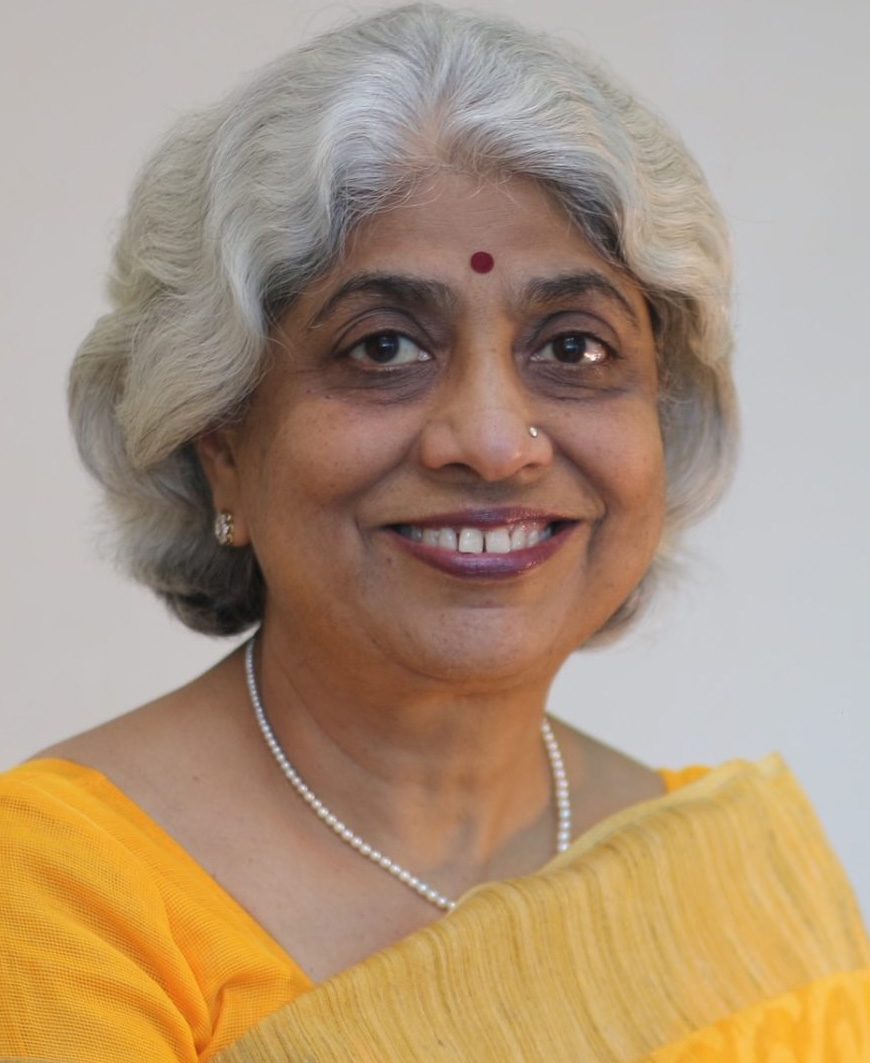
Pathways to Impact is a series of conversations with data for social impact leaders exploring their career journeys. Perry Hewitt, Chief Strategy Officer of data.org, spoke with Veena Mankar, the founder of Swadhaar FinAccess, a nonprofit focused on financial education and inclusion in India.
How did you come to do this work? How did you transition from traditional MBA banking into the social impact work that you do?
The transition was, in a way, serendipitous. I was running a non-banking finance company as a joint venture for three very large institutions, which included IFC, a public sector Bank, and an international bank at that time.
My son was in Standard 10, and he had fallen ill that year. I took a career break to support him. That break also gave me time to consider and act on something I’d been thinking about for a long while: how I could use my skills to deliver social impact.
My father influenced me growing up by saying that you have an obligation after some time to give back, and he gave back in his own way. For example, he used to teach children in slums, and he used to give small loans to people who hawked goods in their neighborhood, or to the milkman who wanted to buy a cow. All this was done very quietly without us knowing. A lot of it I came to know after he passed away.
So, when I took this career break, I started making a business plan of a different type and exploring what I could do with my banking experience. This led to researching microcredit and talking to people who I thought could be the likely recipients of microcredit. These conversations really opened my eyes, because I learned that they were borrowing at over 100, 150, or 200 percent. These small loans mattered; they provided working capital and supported family necessities or emergencies.
One specific example: A vegetable vendor who I bought from regularly for over 20 years asked me once, “you’re in banking, can you help me get a loan to buy a van?” He explained that a van would be something five or six of the vendors could share to transport their wares from the local wholesale market, “the mandi,” more quickly than by train or bus, so they could bring more vegetables in better condition. An introduction to the bank went nowhere for him. I had a similar conversation with our fish vendor – all in all, I spent a year doing informal research.
That was also the time when the Bharatiya Janata Party in opposition fought the election with the message that they would create an India that was shining. Even though they lost, it triggered the thought that, while liberalization in India boosted the middle class, I could see that India is not shining for these people. Rather than go back to my old job, where I was just adding zeros to a profit and loss statement or a balance sheet, I was fortunate enough to be able to shift my career to social impact and founded Swadhaar FinAccess as a nonprofit.
During a career break, I began exploring how my banking expertise could be applied in a new direction. Researching microcredit and speaking directly with potential borrowers proved eye-opening. I discovered that these individuals were often paying extraordinarily high interest rates, sometimes exceeding 200%, yet the loans were genuinely vital for covering working capital, household needs, and emergencies.
Veena Mankar Founder & Director Swadhaar FinAccess
So, the problem you were seeking to solve was around micro-credit / microfinance?
Yes, I was very interested in microcredit and realized at that point that it was very rural-dominated. There were plenty of small businesses in the urban areas, and not much microcredit was available. I decided that I would start in Mumbai, which was the worst decision in hindsight because it’s such a complex market.
But that’s where we decided to start with Swadhaar FinAccess. As events unfolded over the next five to six years, we expanded into more rural areas. But I started with the seemingly impossible dream of seeding microcredit in small groups of 3 to 5 women in urban India, as opposed to large groups of 10 to 20 as was happening in rural India.
We also realized people needed both credit and better knowledge about managing their finances. I remember women coming to tell me they only borrowed for emergencies. The problem was that many of the emergencies were knowable events: a marriage, a birth, a death, school fees – things that require planning. We also had to look at the problem of budgeting and financial planning because people were looking only at cash flow. Financial literacy has become an important component of our work.
Part of the Pathways to Impact series
How does data influence your work, both in the beginning and now?
Initially, we used data to understand the basics, like the interest rates clients were paying and how much they borrowed. These pieces of data were essential for understanding how our loans should be structured.
When we started, our interest rates were somewhere between 34 and 36 percent per annum. It seems very high, but data from their businesses helped us understand that, even at these rates, our clients benefited, as they were making 30 to 35 percent every three or four months on that working capital loan. I think data was very important in understanding the lives of people.
From very early on, we realized that we needed good data to understand the client, to design our products, and to track how a client’s socioeconomic status is improving, if at all.
We have faced challenges with data systems. For example, at one stage, when we migrated systems, we lost all the old data. But we recognized the importance of investing in our own data.
Our own data helped us to understand the way we did our business, but we also used government data to decide where to invest. In urban areas, areas of need were more straightforward; slum pockets were marked out in Municipal Data, and we informally used conversations with bankers to find out the zip codes where banks would not lend.
When we went to the villages, we used government data to really assess the districts where we needed to function. In one instance, we mapped the villages around that data to find how many households were in which villages and how far they were from the district headquarters, to better understand where to locate our centers, how much budget for local travel, and how to reach them. For that program, we had a three-year period to cover 300 villages around a particular office or a center we set up. Our approach to reaching those villages was, by necessity, very much data-driven.
What were some unexpected blockers after you made this transition?
I think the hardest part is the mental shift to this new role. A friend with much more experience in the social sector became my co-founder and offered a lot of helpful guidance. She anchored me in the wisdom of looking at the person you are serving and understanding their perspective.
For example, the first thing she did was to remind me not to call the people we worked with our beneficiaries, but to call them clients. If you call them beneficiaries, you are thinking of yourself in a superior position. Instead, we are servicing our clients and focused on their needs. It was important to forget some of the banking culture and go in and listen to people whom we want to help. One of the changes I had to make was to listen much more.
The second was to double down on perseverance. People don’t want to be told what they don’t know, and there’s a lot of mistrust when you’re talking to people about money. I had to learn to just keep showing up every day. It made our clients confident that we’re not running away, that we’re coming back consistently, and that we are actually there to support them.
What community of people or resources bolsters your work? What role have partnerships played in the growth of Swadhaar?
In the early days, my contacts in the banking sector were important. I reached out for introductions to potential funders. I could also reach out and ask, ‘I’m looking for somebody who’s a CEO,’ ‘I’m looking for somebody from tech,’ etc. I’m still connected to that community today. The other community that helped was the Rotary community. They were working in many of the areas where we wanted to work, so when we went in, collaboration with them helped build trust for us.
Partnerships are essential. I received generous early support from the Michael and Susan Dell Foundation, which fueled a lot of the initial work. And Dell gave us a lot of good advice.
I was also fortunate early on to work with Acción as a partner, which had done so much with individual lending in Latin America. Acción was a powerful technical partner, and they helped us design the product. Unitus, also an early funder, was invaluable at the beginning. All three of these organizations have great experience in social impact and informed our work from product design to our approach to data collection, while also connecting us to other organizations working on the ground.
The important thing is not to go in assuming that you know exactly what needs to be done. You need an idea. You need a concrete proposal for what you want to do in broad terms, but don't fine-tune it without talking to the customer that you want to serve.
Veena Mankar Founder & Director Swadhaar FinAccess
Your banking background definitely shaped the direction of your social impact contribution. What skills are your superpowers in doing this work?
I take for granted the hard skills, but I think it’s the softer skills like collaboration that make a big difference.
For example, I learned that good ideas can come from anywhere. They can come from somebody who has no knowledge in banking at all, like my fish vendor during that early research phase. It can be somebody like the young loan officer who once told me that we needed to increase the amount of training we provided to loan officers. Many of them came from communities similar to those they served, and as a result, had seen and absorbed loan collection practices that were abusive. This was an important course correction for us.
Another valuable skill is being prepared to forget what you know and to re-learn. I developed that skill when I moved from India to the Middle East. I had to forget about the way banking was done in India to do banking effectively in the Middle East.
Finally, always communicate. Don’t be afraid to talk to people about what you’re doing, because you never know where help can come from. For example, when we had projects that failed, I shared that information early on with funders. Don’t let embarrassment block communication. Tell the bad story, as soon as it arises – you can wait to tell the good news!
What advice do you have for someone who wants to get involved in data and AI for social impact?
The important thing is not to go in assuming that you know exactly what needs to be done. You need an idea. You need a concrete proposal for what you want to do in broad terms, but don’t fine-tune it without talking to the customer that you want to serve. There’s a lot you need to know – for example, is my customer digitally native, or digitally naive? You can’t always import a program functioning well in the middle class to lower-income communities. Understanding nuance and context is very important.
Focus is also very important. Don’t get too distracted by other opportunities before you tackle your first!
Overall, in today’s world, there is more funding available for development initiatives and social initiatives than there was when I started. My experience in the financial sector helped me to raise money, but I think today even young people can raise money if they have bright ideas. Ideally, get enough funding to last for three years before you start. Have the source identified: who would be willing to support you if your idea starts to come to fruition? If you’re really bootstrapped, sometimes it’s very, very hard.
What’s the next big thing you see in data and AI in the social sector?
Data is now progressively used to build credit algorithms or other algorithms for products. But one of the problems that we have found is that mainstream large financial players, like large insurance companies, have not really cracked how to design their products in a simplified manner that the customer understands and fulfills the needs of low-income and low literacy households. This means there’s not enough uptake for them to make these products viable in such communities.
We have actually been having a lot of discussion on this, convening roundtables and other group discussions to talk to people in fintech, insurance, and banking. And they point to the challenge of customer uptake of products. They want to know if they are selling to the wrong customer or if they are selling the wrong product.
To address this product-market fit challenge, we believe there’s a need for a customer readiness index, which addresses not only what a household is all about, but also what their environment is all about.
That would allow us to show these companies that this particular community is ready for your product. That would help companies decide whether to come in and do some education or infrastructure building in some communities before diving in.
We’re in the very, very early stages of working on this index with a behavioral research firm. At the moment, our objective is to identify a set of parameters and test the data with both users and financial service providers. Thereafter, we seek to make this data available so that it benefits both the customer and the companies that are trying to get products ready for this market.
Secondly, of course, AI is emerging fast. We see an opportunity to look at the customer data and better anticipate where they are in their financial journey and what sort of information they would like. We’re building a product akin to a WhatsApp dialogue. The customer sends us a question, and then we either try to show them appropriate products or guide them towards information about managing the financial aspects of their family, or maybe just answer the questions they have. AI would help us learn much more about this customer by analyzing the data in our system on the fly.
Finally, in a world of data and AI, storytelling still matters. I spoke to a company recently that is making what they call mini dramas on digital media. They make multiple episodes and then use AI to change them into different personas, in different languages. These are little stories in which financial instruments are used, or financial decisions are made very visible, so people can understand the benefit or impact of their decisions.
Stories are very powerful, as we all know. If you tell somebody a simple explanation, it doesn’t carry as much weight as if they can learn in a narrative format, ideally in a story featuring somebody like them.
What’s your don’t miss daily or weekly read?
I read a lot, and at any point in time, I’ve got one nonfiction and one fiction going. One of the books currently on my bedside table is “Why We Remember: Revealing the Hidden Power of Memory” by Dr. Charan Ranganath.
The daily paper I read now is The Mint, which has a great distribution of daily news: interesting stuff on what’s happening in the global economy and recent developments in AI. I also read a couple of blogs on the tech world to improve my understanding of how fast digital data and AI are taking over. To relax, I also play the New York Times games every day!
About the Author
Chief Strategy Officer Perry Hewitt joined data.org in 2020 with deep experience in both the for-profit and nonprofit sectors. She oversees the global data.org brand and how it connects to partners and funders around the world.
Read moreSeries
Pathways to Impact
This data.org series interviews leaders in Data Science for Social Impact with a lens of how they got there, as well as the skills and experiences that have fueled their career progression.