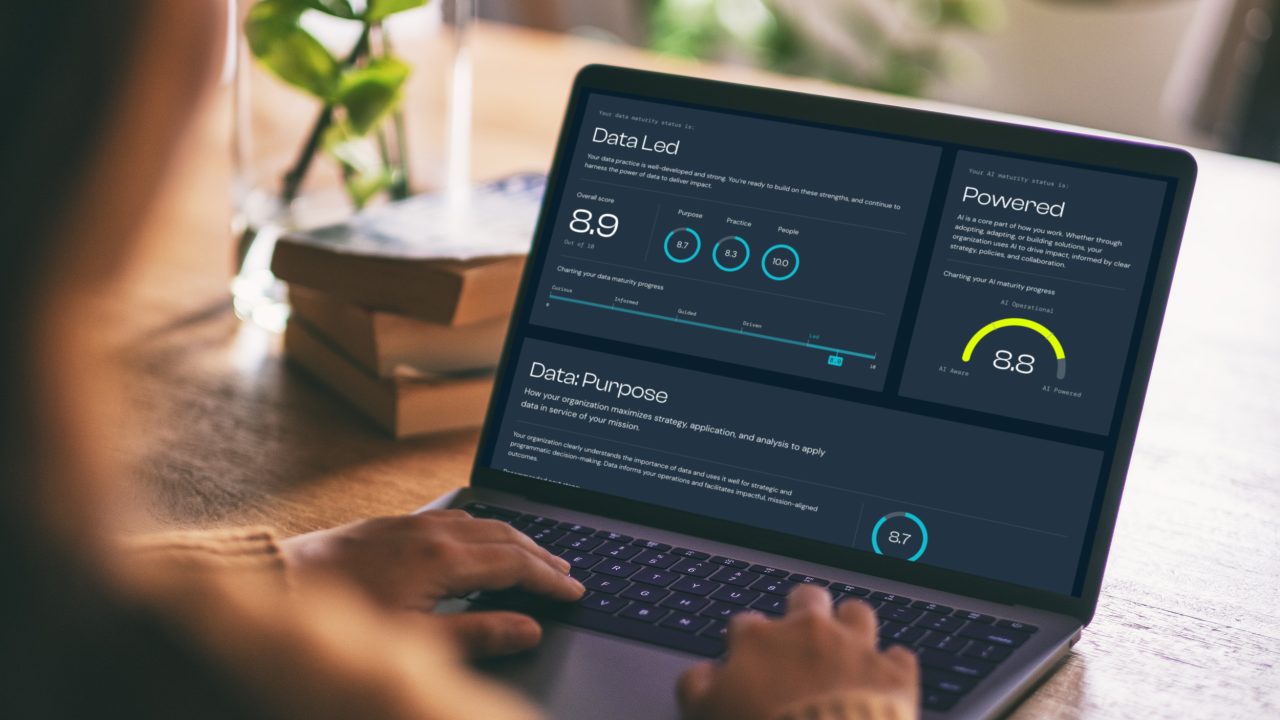
data.org launched our Data and AI Maturity Assessment tool in 2022. It was the same year that ChatGPT was released—the moment at which the AI revolution took hold in many people’s daily lives. Fueled by this rapidly changing landscape yet informed by years of experience helping the social sector to more effectively leverage data, we sought to create something tangible: something that would inspire thoughtful discussion and inform meaningful action.
In the four years since, the DMA has evolved alongside the sector to provide participating organizations with not only a snapshot of strengths and opportunities, but also a self-service roadmap for how best to invest in and prioritize data and AI for impact.
A milemarker for where they are today and the potential that lies ahead to accelerate their data and AI journey.
For us, the DMA works like a mirror. It helps teams see where they are strong, where the gaps are, and where different people inside the same organization may be seeing things differently. More than the score, its real value is the conversation it enables.
Vaibhav Mishra, Co-founder of 10x Impact Labs
Expanding DMA’s Reach with 10x
10x Impact Labs is a social impact consulting firm focused on product, tech, data, AI, and design, working with nonprofits, philanthropies, and state governments—including the Indian states of Karnataka and Rajasthan—to build better tech strategies. They help organizations determine which tools to build, how to drive impact, and whether potential solutions are scalable given in-house capacity.
Partnering with Dasra as part of their suite of knowledge programs, 10x considers data.org’s DMA the starting line for any successful data and AI voyage. They use it as a baseline assessment within the MEAL process: Monitoring, Evaluation, Accountability, and Learning, and from there can map out the next one to three years.
“At 10x Impact Labs, many organizations come to us with a clear ask around data, MEAL, dashboards, or AI, but often the first question is not what to build. The first question is where the organisation actually stands in its data journey,” said Vaibhav Mishra, co-founder of 10x Impact Labs, adding that they considered creating their own tool but decided against it when they discovered the data.org DMA. “The DMA gives organizations a simple, structured way to understand their maturity, both at an individual team level and collectively as an organization.”
Mishra called the DMA a “reality check” for organizations, helping them make data-driven decisions and reducing the risk of reflection and self-assessment through rose colored glasses.
“For us, the DMA works like a mirror. It helps teams see where they are strong, where the gaps are, and where different people inside the same organization may be seeing things differently. More than the score, its real value is the conversation it enables,” he said.
Dots on a Map: From Conversation to Impact
In recent 10x engagements—one with a global non-profit working for climate and environment and one with a sports organization working to enable access to sports in India—the conversation that the DMA has fostered has been transformative.
Comparing results from different team members taking the same assessment surfaced significant insights. Teams were then able to develop a shared understanding and shared language that informs a more honest and practical roadmap.
“After completing the DMA, we realized that different team members had very different interpretations of MEL, data, and AI, each shaped by their own role and experience,” said Mishra. “This completely changed our approach. Instead of delivering the same training to everyone, we redesigned the capacity-building programme to first establish a common understanding across the team before moving into more advanced topics. The DMA helped us identify what needed to be strengthened first, making the recommendations more practical and grounded in the organisation’s current reality rather than jumping directly to technology solutions.”
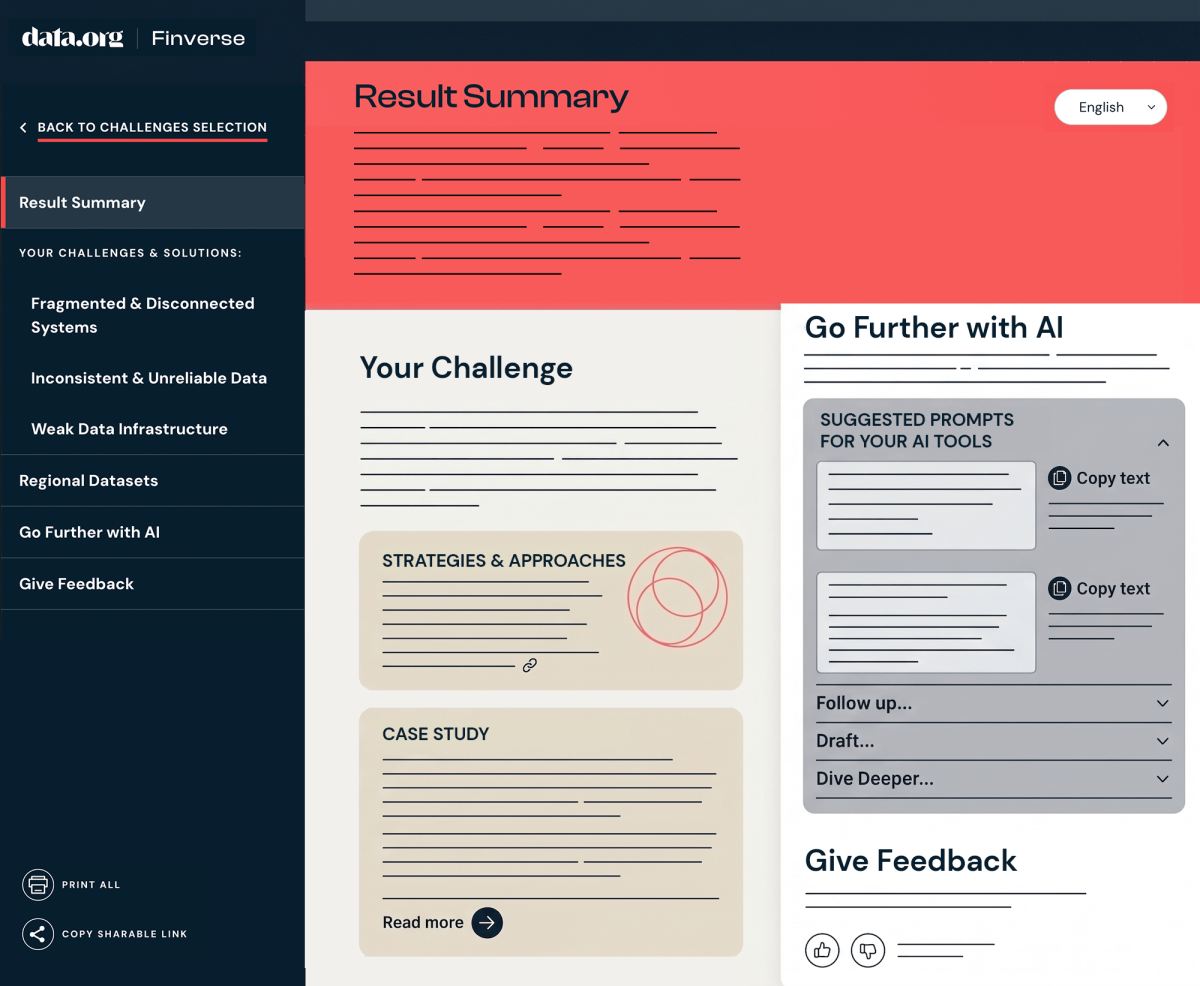
data.org’s broader library of resources has also proven essential to developing that roadmap. Assessment results are paired with relevant materials that are agnostic on software and methodologies but immediately actionable. Across a growing learning cohort —more than 4,900 completions of the DMA to date—data.org is supporting organizations to break down their data and AI journey into smaller, more manageable steps.
Each small step represents an evolution along the data and AI maturity continuum. And with each step, data.org is there as part of a global network of data and AI for impact partners, meeting organizations where they are and helping them build greater data capacity, better leverage AI, and become a more technologically savvy operation in service of communities around the world.