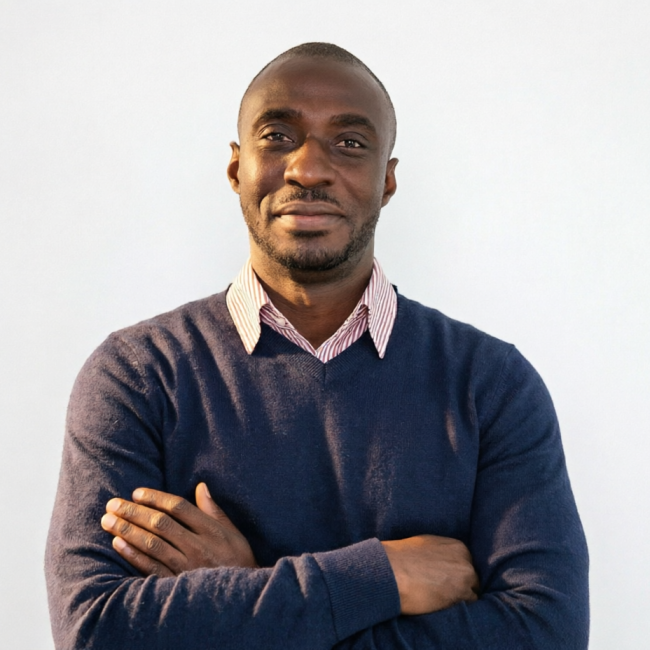
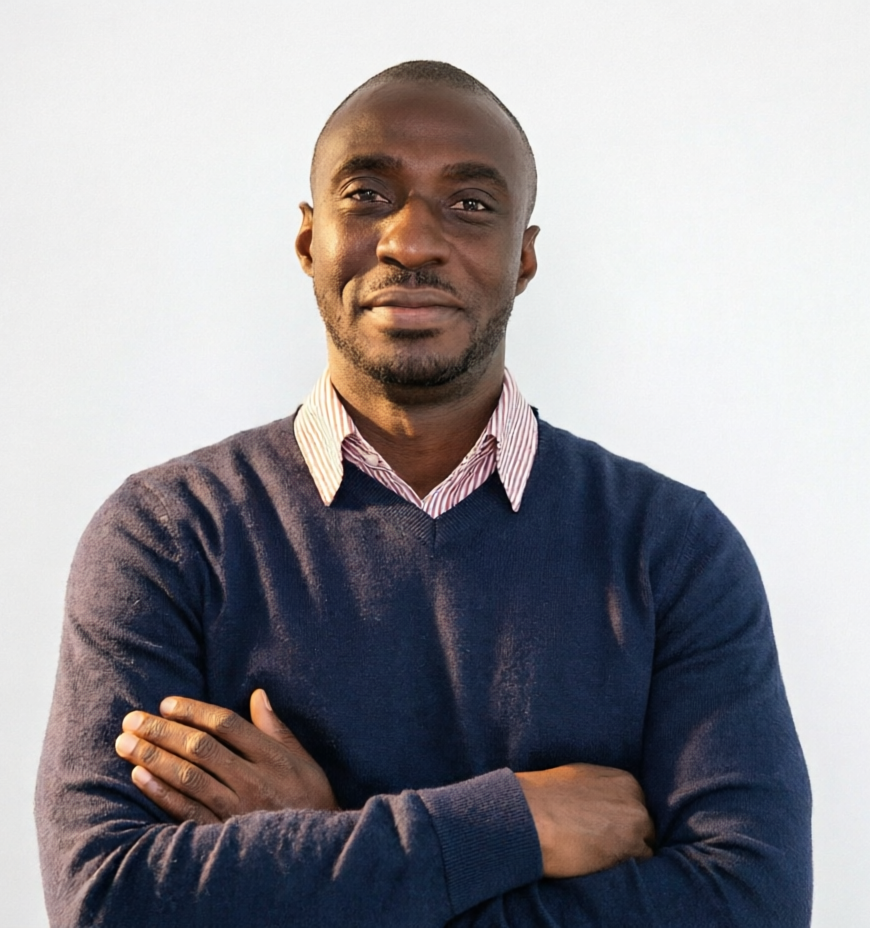
Philip Owusu Antwi is a molecular biologist by training and Project Coordinator of the Real Time Interface for Mapping Cancers and Cancer Service Centers Project at Ensign Global University in Ghana. He spoke with us shortly after being admitted to a fully funded modeling program for pandemic preparedness—a place he credits to his experience with data.org’s Epiverse training.
What brought you to this work?
I’m a Molecular biologist by training. What brought me into the world of data was that I work in a lab setting, and also in the public health space–and we tend to generate a lot of data. Data is becoming a bigger and bigger part of a molecular biologist’s job—and of the public health space generally.
Previously we’d outsource the data work. We’d bring in people to analyze it for us, or we’d have a data person on the team doing the analysis. And I kept thinking: how would it feel if I had the requisite skills to work in the lab as well as the skill set to analyze the data myself, make meaningful contributions from that analysis, and translate it into policy or other action?
I was searching online for epidemiological training of some sort. That’s when I came across the Epiverse community.
What was the blocker you needed to solve?
We generate tons of data in daily activity. And if you’re not trained as a statistician or a data analyst, it’s hard to make meaning from it. I’m talking about datasets in excess of tens of thousands.
So I thought with all this data we’re generating, I should have the technical skills to derive insights from this data myself.
There’s another reason for this. In public health, it’s quite unusual—and not always comfortable—to need other people to access your data. Sometimes you don’t want too many different people to know what you’re truly working on. Being able to do the analysis myself removed that concern. And it’s made me a much bigger asset to my team.
How would it feel if I had the requisite skills to work in the lab as well as the skill set to analyze the data myself, make meaningful contributions from that analysis, and translate it into policy or other action?
Philip Owusu Antwi
What was the training you received?
Epiverse Fellow Joshua Aniaku started us out with the fundamentals. How to write basic code in R and gave an introduction to the various panes in RStudio—the environment, the console, the terminal, the four compartments.
From there, he moved us to simple computations and then introduced us to the various packages. With all of it, he used test cases to teach us not just what a package is, but how to really use it to make the most out of our data.
On several occasions, he invited Dr. Kenneth Enwerem from Nigeria, also an Epiverse Fellow, to give us a different perspective. His teaching was equally fabulous, leaving us with a deeper understanding of how and when to use different tools and approaches.
What was the impact?
The icing on the cake is the training I’m in right now: Modeling for Pandemic Preparedness and Response organized by the German West African Center for Global Health and Pandemic Prevention. It’s a fully funded program aimed at training African scientists, epidemiologists, and mathematicians to become modelers.
I couldn’t have done any of this without the Epiverse training, and I say this because getting into this program had two components before you even become a participant. After you apply, you sit a competency test, and then you sit another competency test in R. I had every answer correct. That’s why I’m here.
The opening ceremony was yesterday, and that was the moment I really appreciated what Joshua and Kenneth had done for us through Epiverse.
Right now, our lessons are on Ebola outbreak modeling. We’ve also looked at influenza, COVID-19, and other respiratory infections with pandemic potential.
What’s the potential for these solutions to travel?
I can easily do this modeling work now. That’s where the foundation Joshua and Kenneth gave us really comes into being—I don’t think I would have been able to assimilate the content they’re teaching me now without the training I received from Epiverse.
Now I can replicate this on my own. I can choose different settings, change parameters, or even build the models from scratch and do it myself. Beyond my own impact, I have started teaching a group of four coursemates in my MPhil One Health class how to clean their datasets, analyze them, and produce meaningful, publication-ready graphs from them, a skill set I believe would help them greatly in their thesis work and position them for jobs. I’m also planning to take a group of public health students through introductory R lessons. In the near future, I hope to introduce and train even larger groups of people on introductory data science with R because, like Dr. Kwegyir Aggrey, I believe in education as a transformative tool.
“5 Minutes with” series
These articles share the stories of people around the world leveraging data and AI to drive impact.