AI is driving the conversation. Corporate investment in AI has surpassed $600 billion, and generative AI has reached more than half of the global population within three years. Artificial intelligence is omnipresent from the C-suite to our kitchen tables.
But if AI drives the conversation, what drives AI?
It’s a question I’ve been thinking about a lot lately, especially as I reflect on a busy week in New York with the UN General Assembly and Climate Week, which brought together some of the world’s foremost leaders, thinkers, and doers to consider this nuanced issue. Across conversations and convenings, it is apparent that collective optimism is hedged by unresolved questions and fears about how – or if – data and AI can be harnessed to do good in the world.
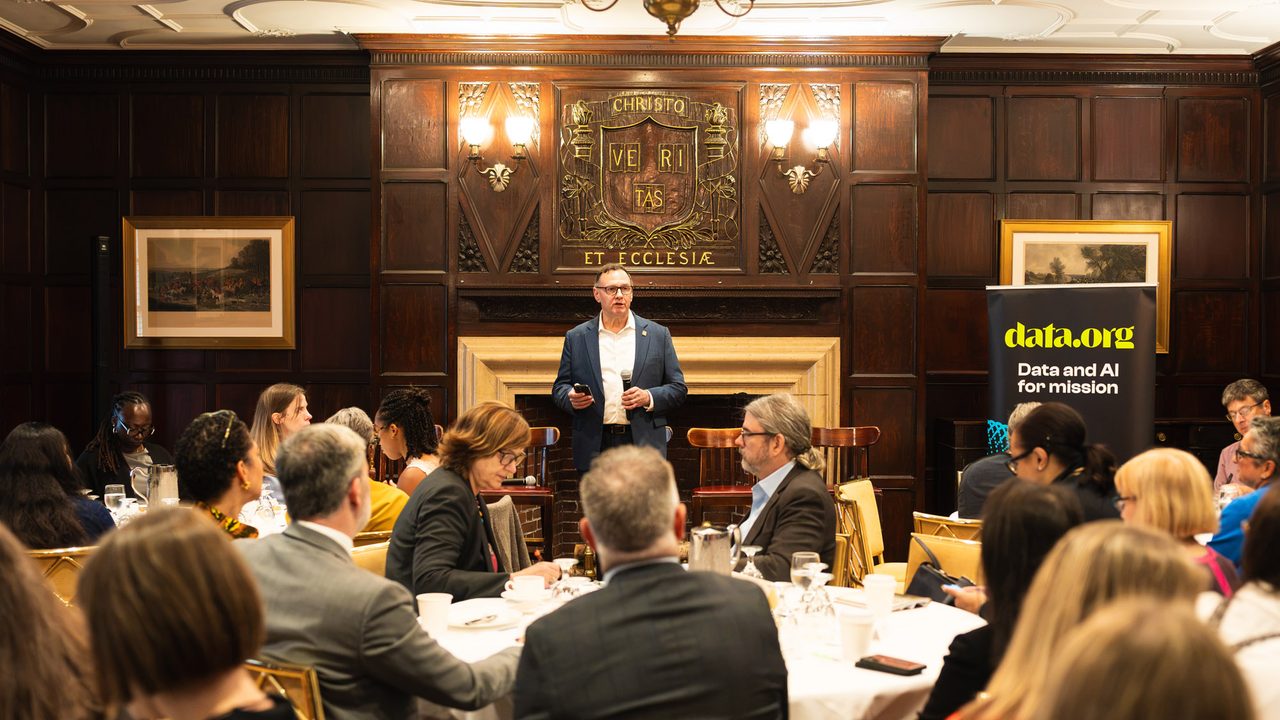
At our data.org Breakfast Briefing, Tomas Lamanauskas, Deputy Secretary-General of the International Telecommunication Union, referred to it as “the optimism gap.”
Joining Tomas on a panel I was privileged to moderate were Josh Kallmer of Zoom, Vivian Schiller of The Patrick J. McGovern Foundation, and Shamina Singh of the Mastercard Center for Inclusive Growth. My colleagues agreed that algorithms are only as good as their inputs, and while tech companies and funders pursue innovation at the speed of, well, AI, the underlying assumptions around data quality are on increasingly shaky ground. There is a systematic proclivity towards what’s new and next, towards solutions that sound sexy, but are not necessarily sustainable. This point of weakness is not a new failure but a persistent and troubling trend in international development. It means that funding flows more easily to the latest tools and well-intentioned yet untested pilots while the well runs dry for the human and technical infrastructure that makes truly transformative strategies possible.
Too often, no follow-on funding is earmarked for the next phase. Much has been said about algorithm biases; this represents a capital allocation bias. Models need retraining; data must be cleaned and databases maintained, yet funding doesn’t always prioritize these ongoing costs.
Organizations using low-quality or biased data will produce predictably low-quality results. The model isn’t the weakest link—the data is—and continued lack of thoughtful regulation only increases the risks of unintended consequences.
At our event last week, we discussed the mechanics of shoring up data foundations without hitting pause on progress. Scaling successful approaches and building capacity are the spaces in which data.org is perhaps best known. Through our global innovation challenges and convening power, we surface and scale breakthrough ideas, and act as impact-oriented grantmakers that help investments go farther with cohort learning and hands-on mentorship. Through five locally led and globally informed hubs from the US to APAC, we have created skilling and experiential learning fellowships alongside university partnerships that ensure that implementation of data and AI solutions is grounded in what communities need. Because when we build data and AI investments alongside the people and organizations usually left out of the room—small businesses, local intermediaries, under-resourced communities—the whole ecosystem scales faster.
As developments in agentic AI promise to yet again reshape nonprofit operations and program delivery in the next three years. The organizations that prioritize not just making the transition to emerging agentic solutions but to fortifying the fundamental data elements that make their deployment successful are the organizations that will thrive in the long term. Most importantly, they are the organizations that will make meaningful progress on critical global challenges like public health, climate resilience, and financial inclusion. Facilitating and accelerating that progress will define data.org’s next chapter.
With more than two decades of experience across corporate strategy, social impact, and academia, and now four months into my role as CEO of data.org, I see more clearly than ever how the sprint to build the workforce necessary to leverage AI was too often not matched by an investment in operational pillars. The urgency to get this right couldn’t be greater. Unless we redouble our efforts to help organizations address the core challenges of quality data, sufficient data, cyber-secure data, effective data governance, and meaningful AI regulation, the race will be lost.
It is only when we advance on both fronts, both people and practice, that we can put the power of data and AI into more hands for a better world.
About the Author
Lance Pierce is the President and CEO of data.org. He is a board member, philanthropic advisor, former corporate consultant, and executive with global leadership experience in nonprofit organizations, startups, corporate responsibility programs, and sustainable investing.
Read more