Financial health in a changing world
The Asia Pacific (APAC) region is undergoing a significant economic transformation. The region’s middle class is expanding rapidly, reshaping consumption, financial behavior, and digital participation. By 2035, APAC is projected to be home to 3.2 billion of the world’s 5 billion middle-class consumers. This growth is also creating new opportunities for the region’s Micro, Small, and Medium Enterprises (MSMEs), as a larger and increasingly connected consumer base drives demand and opens new pathways for growth.
The opportunity is not simply to bring more people and MSMEs into the formal financial system, but also to ensure that greater participation translates into durable prosperity. Financial health extends the financial-inclusion agenda beyond access and use to the outcomes that financial systems enable: the ability to manage everyday needs, withstand shocks, plan and invest for the future, and pursue economic opportunity.
This distinction is increasingly reflected in how the field understands financial inclusion. The World Bank’s Global Findex now examines financial health alongside access and use, while the Bank for International Settlements distinguishes financial inclusion from financial health: access to financial services matters and so do the outcomes they enable.
For APAC, these challenges coexist. Basic financial inclusion remains unfinished for many, even as greater financial access creates a broader question: how can participation in the financial system translate into greater resilience, security, and inclusive growth?
How can data and AI advance financial health?
Data and AI are expanding how organizations can understand and advance financial health. Better use of data can reveal underserved populations and needs, while AI and advanced analytics can help financial-service providers, MSMEs, and social-impact organizations develop more responsive products, services, and interventions.
However, technological capability does not automatically produce better outcomes. Data may be incomplete, fragmented, inaccessible, or unrepresentative. Recent CGAP research, for example, identifies data availability and quality as major constraints to scaling AI in financial services and warns that gaps in underlying data can reproduce exclusion.
The wider AI transition presents a similar challenge. APAC economies vary significantly in skills, connectivity, compute, data, regulation, and institutional capacity. Even where adoption is accelerating, organizations can struggle to translate experimentation into meaningful organizational change. The Centre for Asian Philanthropy and Society’s research with 42 social impact organizations across 10 APAC economies identified human and organizational readiness as the primary constraint to AI adoption.
The opportunity, then, is not simply to deploy more technology. It is to strengthen the ability of people and institutions to use data and AI purposefully, responsibly, and in ways suited to their context—ultimately in service of better social and financial-health outcomes.
Beyond technology: building the ecosystem around it
Emerging work on AI readiness increasingly treats adoption and diffusion as an ecosystem challenge. The World Bank identifies connectivity, compute, context—including locally relevant data—and competency as foundations for inclusive and effective AI ecosystems.
Relevant capabilities are distributed across institutions:
- Universities develop talent and research.
- Governments shape policy and public infrastructure.
- Companies bring technology and implementation expertise.
- MSMEs, social-impact and community-led organizations bring proximity to markets and communities, and understand their needs.
- Funders, multilaterals, and regional networks mobilize knowledge and resources.
Together, these capabilities can support more effective and responsible adoption of data and AI for the communities they are intended to serve. Bringing them together requires extensive ecosystem-building work.
The CAN APAC Journey
From a regional capacity hub to a financial-health focus
With support from Mastercard Center for Inclusive Growth (CFIG), the CAN APAC Hub was launched at the National University of Singapore (NUS) in 2024 as the fifth regional hub in data.org’s global Capacity Accelerator Network (CAN), joining hubs in the United States, India, Africa, and Latin America. From the outset, it was designed as a regional hub within a globally connected network: grounded in APAC’s institutions and priorities while drawing on and contributing to resources, approaches, expertise, and relationships developed across CAN.
The Hub launched with a focus on applying data and AI to systemic financial-health challenges for MSMEs and community-driven organizations while building a workforce of purpose-driven data and AI practitioners across the region. The Asian Institute of Digital Finance (AIDF) at NUS and the Association of Pacific Rim Universities (APRU) joined as core partners. This reflects CAN’s broader approach of investing both in purpose-driven data and AI practitioners and in the capacity of organizations to employ that capability responsibly.
Financial health has provided a principal regional focus, connecting APAC’s strengths in data, AI, and fintech with the challenge of enabling communities and MSMEs to participate in and benefit from financial systems. The work has also extended into interconnected areas—including food security, climate resilience for MSMEs, and sustainable livelihoods—that shape the financial health and well-being of communities.
An ecosystem approach to capacity building
In a diverse region like APAC, institutions enter the AI transition from very different starting points. The Hub’s response has been to work with institutions and networks already embedded across the region, meeting them where they are, rather than attempting to build every capability independently. Over time, this work has developed across three interconnected dimensions:
- Developing purpose-driven talent by creating opportunities to learn across disciplines and apply data and AI to real financial health challenges.
- Building organizational readiness by helping MSMEs, social-impact and community-led organizations identify meaningful problems and strengthen the people, practices, and systems required to use data and AI effectively.
- Connecting partners, initiatives, and resources so expertise, learning, opportunities, and tools can travel across institutions, sectors, and geographies.
These dimensions reinforce one another. Talent becomes more valuable when organizations can put it to use; organizational capability grows when institutions can access relevant expertise and resources; and regional networks become stronger when learning and relationships generated through one initiative contribute to another.
CAN APAC Hub impact at a glance
CAN APAC works through people and organizations already embedded in communities, institutions, and markets across the region. By directly engaging practitioners and organizations, and working through partner networks that can take learning further, the Hub uses a multiplier model for impact: strengthening data and AI capacity to ultimately benefit the millions of people and MSMEs these organizations serve.
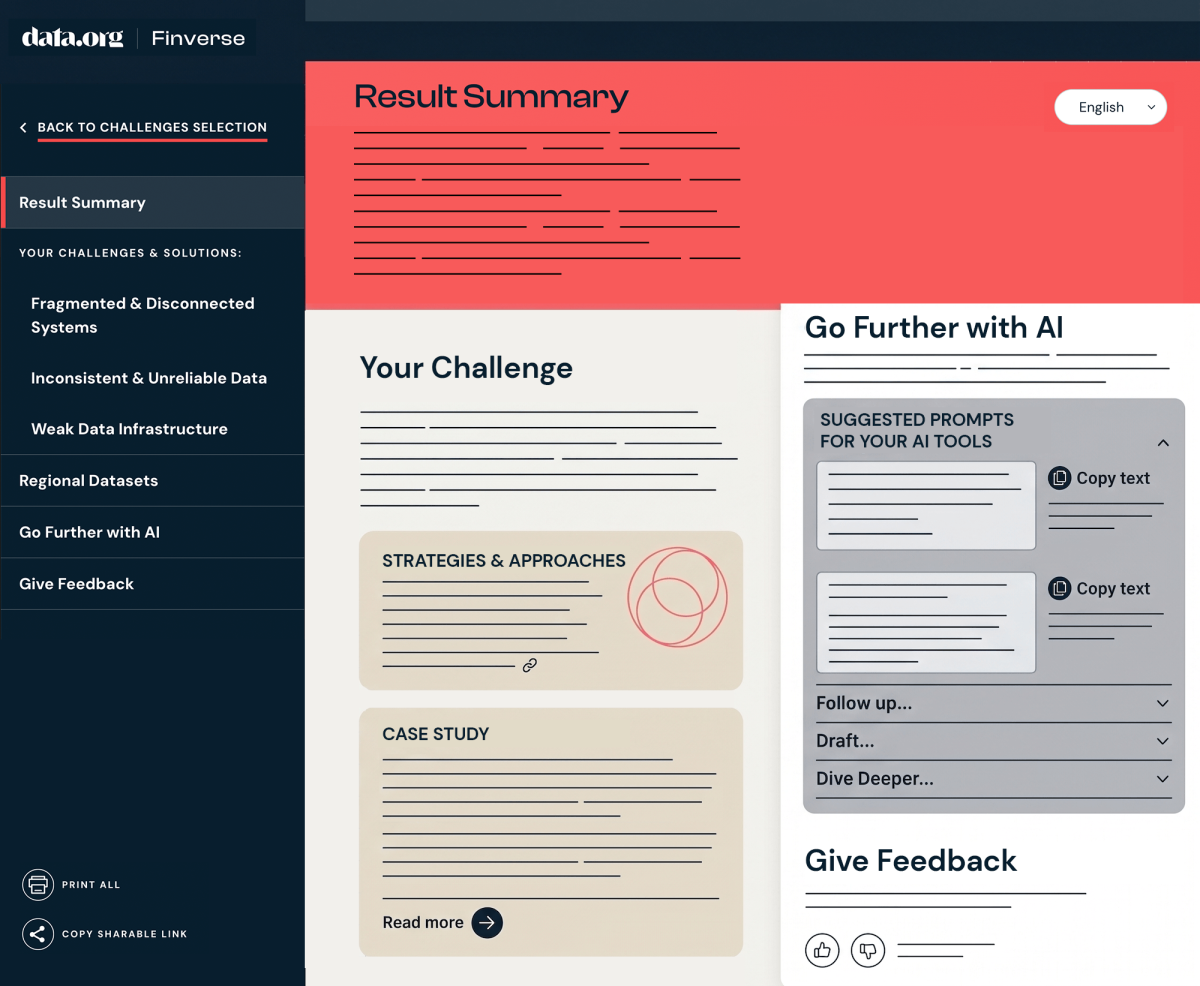
- Customized Data and AI recommendations provided to 368 FSPs, FIs, MSMEs and other organizations serving 72M+ people
- Learning resources localized for 20M+ individuals in Asia
- 4,400+ data and AI for impact practitioners trained and engaged
- 1,650+ organizations supported through data.org’s tools, learning resources, and ecosystem initiatives.
- 20+ APAC economies engaged through data.org’s global Capacity Accelerator Network
Behind these numbers are the people, organizations, and partnerships bringing this work to life—their experiences and voices are woven throughout the sections that follow.