Understanding the Challenge
The growing use of data and AI across financial health is increasing demand for practitioners who can work effectively with these technologies. But technical skills alone are not enough. Real-world problems rarely arrive as clean datasets or clearly defined analytical tasks. Practitioners must understand the context behind the data, work across disciplines, navigate questions of ethics and inclusion, and translate technical possibilities into approaches that organizations and communities can actually use.
Traditional learning environments do not always develop these capabilities together. Students may build strong technical or disciplinary expertise without sustained exposure to implementation challenges, while professionals may have limited opportunities to apply emerging data and AI skills to complex social problems.
The talent challenge is therefore not simply to produce more technical specialists, but to develop data-to-decision translators: purpose-driven practitioners who can bridge technical capability, domain knowledge, and organizational context to turn data and AI into useful decisions and action. This translation role can sit within technical, domain, policy, or program teams; what matters is the ability to connect different forms of expertise around a real-world problem.
Our Approach
The CAN APAC Hub approaches talent development as a continuum between learning and application. Foundational knowledge matters, but translator capability develops through practice: applying knowledge to real problems, navigating implementation constraints, receiving feedback from practitioners, and working alongside people with different expertise.
Three principles shape this approach:
- Experiential learning creates opportunities to move from understanding concepts to applying them. Programs use real or realistic financial-health challenges that require participants to interrogate evidence, develop solutions, make trade-offs, and communicate their thinking.
- Bridging academia and practice connects learning environments with organizations and practitioners working on these challenges. Universities provide academic and technical rigor, while government, industry, MSMEs, and social-impact organizations bring domain knowledge, implementation experience, mentorship, and real organizational problems.
- Building interdisciplinary capability recognizes that effective uses of data and AI require multiple forms of expertise. Technical disciplines work alongside fields such as finance, policy, health, agriculture, design, law, and the social sciences.
These principles take different forms depending on the depth and objective of the learning experience. Courses provide accessible foundations at scale; case competitions introduce learners to complex problem-solving; and hackathons create extended opportunities for solution development and iteration.
In Practice
Hackathons
Hackathons have become one of the APAC Hub’s flagship approaches to experiential learning. Designed as multi-month learning journeys rather than standalone competitions, they bring interdisciplinary teams together around real-world challenges, combining solution development with practitioner exposure, mentorship, and structured learning.
APAC Hackathon Model
01Challenge definition
Challenge statements are shaped with ecosystem partners to ground participants’ work in regional priorities and implementation realities.

02Team formation
Multidisciplinary teams, endorsed by their employers or faculty, bring together fields including computer science, engineering, economics, business, law, public policy, design, and the social sciences.
03Solution development
Teams move through successive stages of need assessment and solution development, preparing policy briefs, prototypes, or minimum viable products depending on the program.
04Capacity building & mentorship
Mentors from academia, industry, government, multilaterals, and the social-impact sector help participants interrogate assumptions, strengthen technical approaches, navigate policy and implementation questions, and communicate their ideas.
05Final convening
The journey culminates in an in-person, regional convening where finalists present their solutions to judges and ecosystem leaders while connecting with peers, mentors, and partner organizations.
Teams are provided travel support, covering flights, accommodation & meals. They stand to win cash prize, certificates & showcase opportunities.
06Post-hackathon engagement
Post-hackathon pathways include opportunities for selected participants to engage with organizing partners’ wider innovation ecosystem networks.
Evolution of the Model
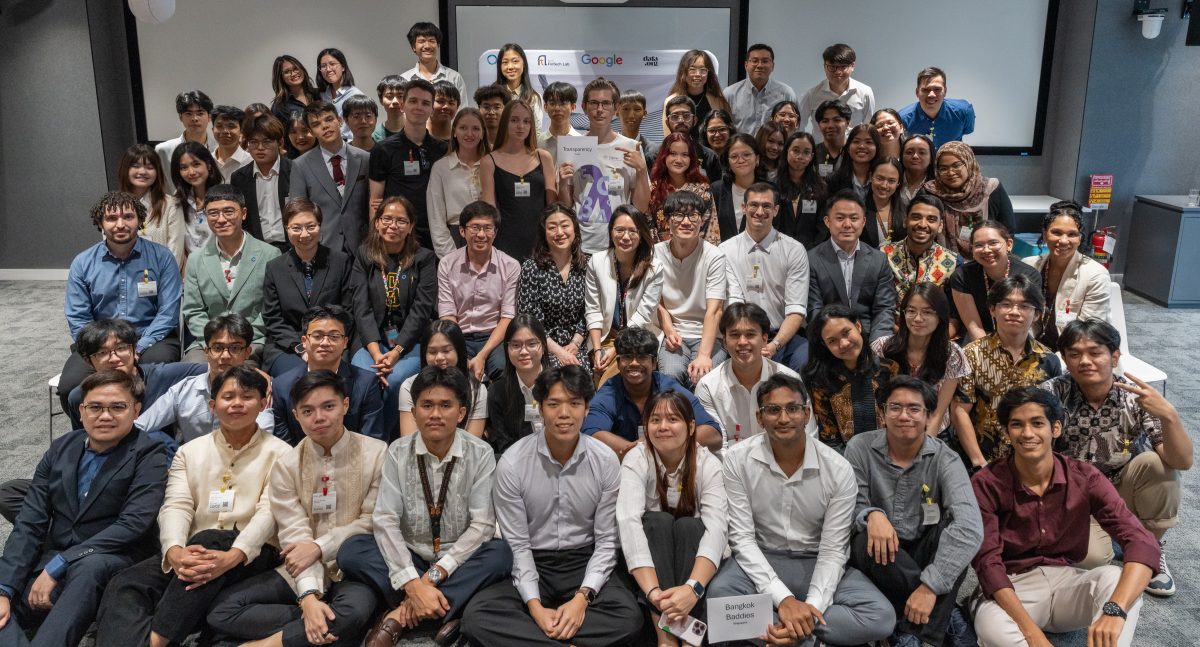
The inaugural APRU Tech Policy Hackathon 2025, convened by APRU in partnership with data.org and the NUS FinTech Lab, with support from Google, focused on leveraging AI and data for inclusive growth. Nearly 300 participants from 15 economies developed policy-informed solutions across financial inclusion, digital trust, AI governance, and climate resilience. Following several months of mentorship and solution development, finalists convened at Google’s Bangkok office. The program was subsequently recognized with the Best Use of EdTech in Higher Education Award by the EdTech Innovation Hub.
Voices from the Hackathon
The hackathon pushed me to think beyond my own perspective and develop a stronger global mindset — how others build, communicate, and compete on a regional stage.
Samuel Y. Susanto, member of the winning team, which developed an AI platform to harmonize fragmented lending data to assess creditworthiness for underserved MSMEs in Indonesia.
The hackathon provides a platform to unpack policy challenges unique to Southeast Asia and empowers students to approach them with fresh thinking, regional sensitivity, and innovative solutions.
Yinghui Tng, Google, Funding Partner
Detailed report about the hackathon in 2025:
The 2026 Data, AI & Policy APAC Hackathon: Financial Health Frontiers, supported by Cognizant and delivered by data.org, APRU, NUS FinTech Lab, the Asian Institute of Management (AIM), and Nasscom, is built on this foundation.
Launched at NUS following a dialogue involving more than 20 leaders from technology, finance, philanthropy, academia, and social impact, the second iteration strengthened several elements of the model:
- Real-world organizational challenges: Challenge statements were developed with organizations working directly on financial health, giving teams more specific implementation problems to address.
- Structured learning alongside solution development: A four-part Financial Health CANversations series brought practitioners into the learning journey and was subsequently opened to the wider ecosystem. This was complemented with an online introductory course on data and AI for financial health, initially developed by NUS-AIDF and adapted into a digital learning offering by data.org.
- Stronger pathways beyond the competition: Selected participants gained opportunities to connect with wider innovation and practitioner networks, including through Nasscom.
Building on the momentum in 2025 and a wider network of organizing partners, the 2026 hackathon attracted 600+ participants from across 15 economies, doubling from the initial iteration.
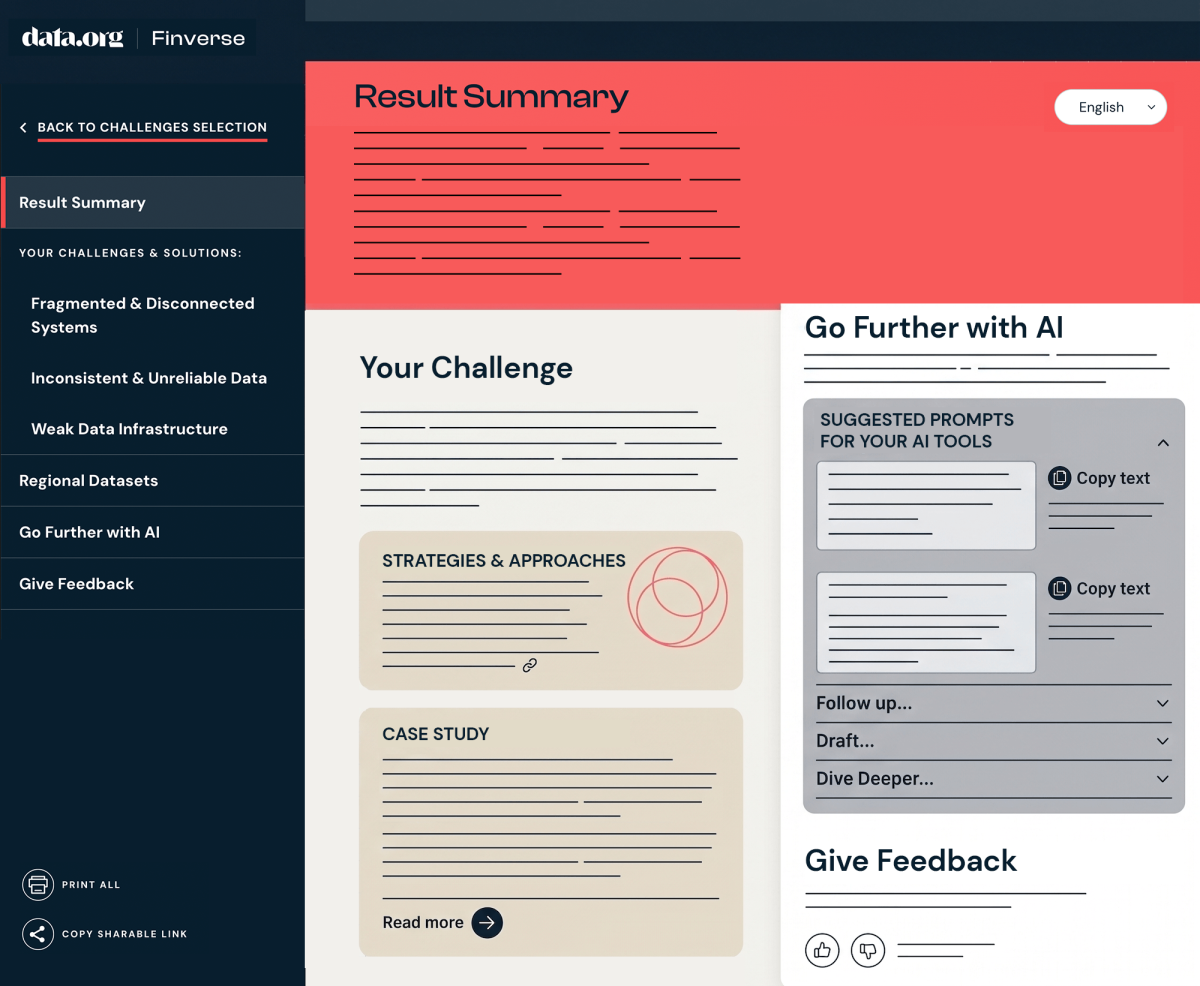
Finverse, data.org’s financial-health tool detailed in a later section of this playbook, created another bridge between student problem-solving and organizational practice. During Phase 2, teams used the tool with real-world organizations to understand their data capabilities and challenges before developing their solutions. This generated several early insights:
- Connecting teams to real-world challenges: 59 shortlisted teams used Finverse with around 55 organizations across 14 economies, spanning banks, microfinance institutions, cooperatives, fintechs, public bodies, and social-impact organizations.
- Revealing common organizational barriers: More than half of teams (30 of 59) identified fragmented or disconnected data systems as a core challenge, often alongside limited data availability, difficulty applying insights, and challenges measuring financial health.
- Creating potential for solutions to travel further: Many participating organizations operate through extensive customer, agent, merchant, or community networks—from microfinance institutions serving millions of borrowers to platforms connecting millions of MSMEs—creating pathways for promising solutions to ultimately reach much larger populations.
Across the two iterations, the model has therefore evolved from a competition centered on interdisciplinary problem-solving and mentorship toward a longer learning journey combining real organizational challenges, structured capacity building, practitioner exposure, and stronger connections to the wider ecosystem.
Case competitions
Case competitions offer a complementary model for experiential learning at scale. They engage geographically dispersed learners around a shared problem without requiring teams to build functional prototypes or participate in intensive in-person development.
APAC Case Competition Model
01Case definition
A complex policy challenge with no single right answer. Teams advise a national / sub-national government or another significant actor, choosing one dimension of the problem to work on.
02Team formation
Interdisciplinary by design. Participants come from fields including public health, data science, economics, law, management, architecture, international relations and social sciences.
03Evidence and data analysis
A case pack introduces the sector alongside data quality, bias and the limits of AI. Teams examine the wider system, test what existing datasets can and cannot show, and ask whose perspectives are missing from them.
04Recommendations
Findings become a staged strategy: what to do, in what order, and how different forms of evidence should inform the policies and programmes that carry it.
05Communication
Each team presents its solution in plain language, targeted at decision-makers rather than for specialists in their own field.
06Expert review
An international jury of domain experts as well as data and AI experts drawn from several economies assesses every submission and selects the finalists.
07Wider practitioner forum
Finalist work is showcased at a global conference, bringing student analysis into a wider forum of academics, practitioners, government representatives and other sector leaders. Because the competition runs virtually, reach is wide: the most recent edition drew 110 teams from 26 universities across 13 economies.
The CAN APAC Hub applied this model through the 2025 APRU Global Health Virtual Case Competition, an established annual initiative of APRU’s Global Health Program, hosted by the University of Southern California. In its tenth edition, the competition incorporated data and AI with support from data.org, with the United Nations Development Programme (UNDP), Food and Agriculture Organization (FAO), and Universiti Malaya contributing as strategic partners.
Focused on Advancing Inclusive Growth in Southeast Asia by Leveraging Data and AI for Food Security, the competition tasked the participants to act as advisors to a national government and develop a five-year strategy addressing food availability, access, utilization, or stability.
Teams were asked not simply to propose AI solutions, but to examine the wider food system, identify limitations in existing datasets, consider whose perspectives were missing, and explain how different forms of evidence could inform policy and programs. A case pack introduced participants to food systems and food insecurity alongside data quality and bias, responsible AI, contextual understanding, and the decolonization of data. Teams were provided additional resources, including FAO databases and data.org courses on Responsible Data Management and Ethical AI.
The structure was interdisciplinary by design. Participants came from fields ranging from computer and data science, medicine, and biotechnology to economics, law, international relations, architecture, and sustainability science. 110 teams from 26 universities across 13 economies registered, with submissions assessed by 38 global health, data, and AI experts from 10 economies.
Finalist work was subsequently showcased at the APRU Global Health Conference 2025 in Kuala Lumpur, hosted by Universiti Malaya, bringing student analysis into a wider forum involving academics, health practitioners, government representatives, and other global-health leaders. The model creates a route from academic problem-solving to wider practitioner and policy conversations.
Voices from the Case Competition
Our project looked at food access challenges in Indonesia. As we worked through the case, one issue kept coming up: national averages often hide sharp local differences, and those gaps can shape policy decisions in ways people don’t always see. We reviewed major global datasets, identified where they fall short, and proposed a layered data approach. This combined satellite imagery, market price tracking, supply chain signals, community surveys, and social insights, supported by AI tools to improve forecasting and response time. Grateful for the learning!
Jasmine W., Case Competition Participant
Courses
Courses provide a scalable route to foundational data and AI capability. Their value lies not only in reaching individual learners, but in creating modular resources that institutions can incorporate into deeper learning and capacity-building pathways.
APAC Course Model
From digital learning to applied courses
01Open-access course
A free, asynchronous online course, typically with no prerequisites, built as a modular public good and open to anyone.
02Foundational knowledge
Beginner-friendly modules give students, early-career professionals and practitioners a shared grounding in data and AI, aligned to a thematic area.
03Institutional adoption
Because the content is modular, universities, governments and community organizations can embed it in their own programs.
04Hybrid learning
Selected modules feed longer certificate programs that pair digital content with in-person cohorts over several months.
05Applied projects and mentorship
Learners take on industry-linked capstones addressing real problems, supported by mentors and innovation activities.
06Industry exposure and career pathways
Employer exposure, job fairs and placement support turn coursework into internships and first roles.
One resource, multiple pathways
The same open course serves three purposes at once: a standalone entry point for individual learners, a module inside a longer credential, and workforce training adopted at scale inside institutions. New thematic areas extend the model without rebuilding it.
This approach was put into practice through the FinTech Literacy Program, developed by NUS-AIDF. Designed as a public good, the program is free, modular, asynchronous, requires no prerequisites, and takes approximately 16 hours to complete. Its curriculum brings together Ethical AI, Financial Inclusion, and Data Privacy.
The beginner-friendly design enables participation from university students and early-career professionals as well as entrepreneurs and practitioners across government, civil society, academia, and financial services. Within a few months of launch, the program attracted more than 500 learners across 11 countries and 50 organizations.
Its modular structure allows the same learning resource to travel through different institutional settings:
- Community-based learning: In Singapore, data.org signed an MoU with Jamiyah Singapore to use digital learning resources—beginning with the FinTech Literacy Program—to strengthen foundational AI and data capabilities among staff and beneficiaries.
- Higher education and employment pathways: In India, selected modules were incorporated into the Certificate in FinTech and InsurTech, delivered by NUS-AIDF with the Government of Odisha and the Global Finance & Technology Network (GFTN). The five-year partnership aims to train 7,000 students through a hybrid program combining digital learning with industry-linked capstones, mentorship, innovation activities, employer exposure, and placement opportunities.
- Public-sector capacity: In India, data.org is scaling adoption of an abridged version of the course through its longstanding partnership with the Government of India’s Capacity Building Commission, whose learning ecosystem serves more than 17 million civil servants.
- Experiential learning: The course has also been made freely available to participants in the 2026 hackathon as they apply data and AI to real-world financial-health challenges.
The Hub is now extending this model into an adjacent thematic area. In partnership with the APRU Multi-Hazards Program hosted by Tohoku University, RIKA Institute, and Keio University, it is developing an introductory course on AI and Big Data for Disaster Risk Reduction. Designed for non-technical learners across academia, policy, and the humanitarian sector, the course will introduce applications of data and AI to disaster risk reduction while incorporating an MSME lens. It is expected to launch at the 21st APRU Multi-Hazards Symposium 2026 in Korea.
Across these applications, open and modular learning provides a common foundation that partners can extend through institutional learning, applied experience, and community-based delivery.
Last year, I was an Economics student trying to merge my interest in economics with AI and technology — with zero fintech experience. The program became that bridge — leading me to Vayana Network as an Analyst. What means the most to me is this — I’m proof that talent doesn’t need a tier-1 college tag or a head start. It needs the right platform, the right mentors, and the willingness to show up and learn.
Rahul Lal Kiran, graduate of Cohort 1 of the Certificate in FinTech and InsurTech Program who secured a full-time role as Analyst at Vayana

Roza Ahmad
Chairperson, Women’s Committee, Jamiyah Singapore
Starting point
Roza works on initiatives supporting women from low-income families, including an entrepreneurship program designed to strengthen income security and sustainable livelihoods. Through this work, she encounters barriers ranging from limited financial and digital confidence to caregiving responsibilities and uncertainty about how to begin earning independently.
The experience
Through the FinTech Literacy Program, Roza explored financial inclusion, microfinance, generative AI, data privacy, and responsible AI, continually connecting these concepts to the needs of the women Jamiyah serves.
From learning to application
The course has informed how she thinks about Jamiyah’s entrepreneurship program—from introducing basic financial concepts and financing options to exploring how accessible generative-AI tools might support women running home businesses. It also raised questions about how concepts such as AI ethics can be translated into simpler, conversational, and potentially multilingual formats for learners with different educational backgrounds.
While Roza’s participation represents an early step, Jamiyah’s extensive community network creates opportunities for this learning to travel further—from individual practitioners to programs supporting women, families, and entrepreneurs across Singapore.
In her words
“The things that are covered are very practical and something that stays with you.”
Watch Roza discuss her experience during a CANversation
Explore more