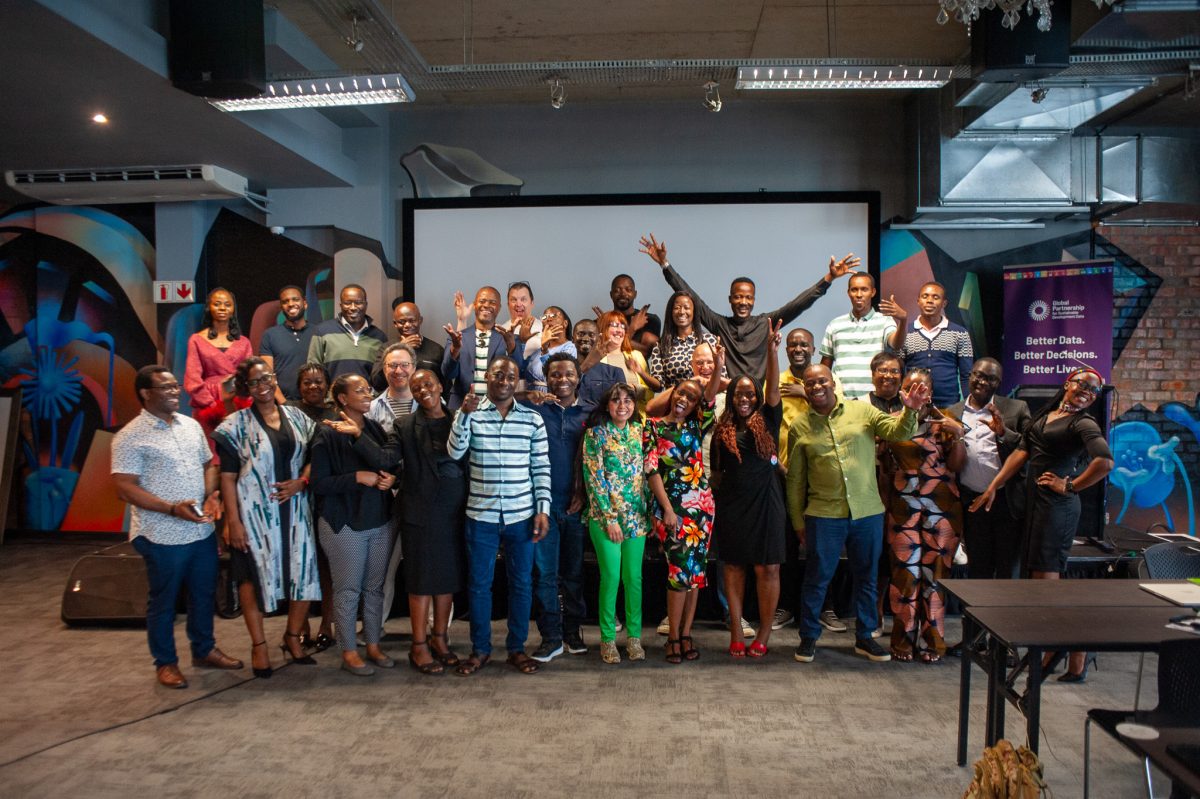
The inaugural three years of Africa CAN yielded a number of key lessons, including how to structure the program; how to foster collaboration; how to access, use, and analyze data for social change; and how to amplify and scale the impact of individual innovations. Each cohort was built upon lessons learned from the previous cohort, and these insights will be applied to future programs aimed at building capacity for data skills in climate and health and beyond, and using these skills for the public good.
We hope these lessons can support anyone looking to use data more effectively to tackle complex and interconnected challenges.
1. There is no one-size-fits-all approach.
What works in Anglophone (English-speaking) Africa does not necessarily work in Francophone (French-speaking) or Lusophone (Portuguese-speaking) Africa. In the first cohort of Africa CAN, a somewhat blanket approach was used to recruit learners across all the different countries, as well as with the different host organizations, whether government agencies or SIOs. However, working with governments and with SIOs requires different approaches. Government organizations tend to be more formal and have specific processes in place when it comes to data management, access, or use. NGOs may have their own frameworks in place but are often more flexible. This was a big lesson learned in the first year: it is important to have different approaches to collaboration for governments and social impact organizations.
Climate and health challenges may vary in how they manifest and are prioritized within countries or regions, requiring context-specific curriculum design. A blanket approach assumes uniformity where significant differences exist. For training to be effective across Africa, it must be linguistically accessible, respect institutional diversity, address context-specific gaps, leverage regional expertise, and build inclusive ecosystems that promote cross-border and cross-linguistic collaboration, without imposing models that may not fit local realities.
2. Institutions want to work with one another.
Since the first cohort, it was clear that while there can be differences in how organizations work and prefer to collaborate, there is strong interest in collaborating within and between governments, and working alongside NGOs or SIOs to address climate and health challenges. Particularly when it comes to the climate and health data space, there’s a recognition of how much work there is to do and a willingness and appetite from organizations to collaborate and learn from one another.
3. Use a network approach.
We learned the value of global collaboration in strengthening regional CAN efforts. Highlights included a training session by Professor David Uminsky (United States CAN Hub) for Africa learners, bilateral exchanges between the Global Partnership and J-PAL South Asia (India CAN Hub), and Fellow-to-Fellow collaboration, such as Dan (Africa) and Anuja (India) working together as peers. These interactions show how cross-hub learning and co-creation drive a stronger, more connected impact.
4. There is a strong appetite for data science training.
Training and capacity-building have always been an essential part of Africa CAN, but at first, the training was viewed as the precursor to the fellowship. As time went on and the initiative evolved, the training took on a life of its own and grew to become an event in and of itself within the Africa CAN calendar. There has been a lot of interest from a range of institutions, from the smallest entities of government all the way to national health ministries. There is also a lot of interest from the organizations within the network to learn from one another.
5. Growth follows depth, allowing the community to grow organically.
Starting with a handful of members in cohort 1, we focused on building trust and relevance before scaling. By using accessible platforms like WhatsApp and LinkedIn, we created low-barrier spaces for ongoing peer exchange and support. Rather than centralizing control, we fostered a culture where members could lead conversations, which strengthened ownership and sustainability. The community also benefited from a balance between digital engagement and in-person interactions, such as meet-ups and in-country workshops, which helped transform online connections into real-world collaboration. Social media shares by learners played a vital role in organically expanding our reach, while our willingness to listen and adapt to evolving needs has kept the network vibrant, inclusive, and member-driven. By mid-2025, we had over 1,500 community members including data scientists, academics, independent researchers, and government officials.
6. Lusophone Africa is keen to take part.
So far, Africa CAN has focused on Anglophone and Francophone Africa. However, following an event in Cabo Verde in 2024, where representatives from countries in Lusophone Africa discussed some of the challenges they were facing around climate and health issues, it was clear there was an appetite for a similar training from a Lusophone perspective, tailored to their regions and language. A targeted training program for the Lusophone countries is now being developed. The interest within Francophone Africa in data science skills has also been exciting to see, and Africa CAN partners are keen to expand the work in these countries, as well as continuing to work with Anglophone Africa.
7. Data collection and access are recurring challenges.
One of the biggest challenges the Africa CAN Data Science Fellows faced was accessing the data required to deliver their innovative projects; this data was often held by various separate organizations and in different formats, or sometimes did not exist at all. For example, when working with the Kenya National Bureau of Statistics to develop a new model for carbon emissions monitoring on Kenya’s roads, Africa CAN Fellow Agnes Okero collaborated with various organizations across sectors to access the data she needed to build a more comprehensive dataset. While the Global Partnership and Africa CAN partners brokered connections, Agnes worked with the various organizations to make the case for sharing their data, including setting up ethical data-sharing agreements, in alignment with Kenya’s relevant climate policy goals. Then, having successfully negotiated the agreements, Agnes worked to integrate diverse formats, digitize records, and implement quality assurance protocols to enable efficient sector-wide analysis.
8. Capacity-building can help make the case for data access.
Inter-governmental data sharing has proved challenging because it involves different levels of access. For instance, Africa CAN Fellow Enock Mwesigwa, in cohort two, worked with the Uganda Bureau of Statistics and needed cholera statistics held by the Ministry of Health. In this case, the Global Partnership was well placed to act as an independent third party to support establishing those links and processes. However, capacity-building through the Africa CAN program also helped with this. It’s important that those working within the different ministries understand what data is needed and why. The Africa CAN training helped to raise awareness of how data science can support government organizations to achieve their missions and empowered participants to make the case for ethical data sharing. Organizations may not understand the need for other institutions to have access to their data; the training helped to empower participants to advocate for data access and to increase awareness of the merits of ethical data sharing.
9. With data, effective storytelling is key.
There has been a lot of interest in the innovations developed through the Africa CAN Fellowship, and sharing this work via Fellows’ own online networks, through partners’ communication activities, and with the media has helped to raise awareness of data-driven approaches to pressing challenges and to amplify the impact of this work. However, while they have strong data skills, Fellows are not necessarily experienced in communications. Supporting Fellows to share their work and stories through media training and storytelling workshops helped to empower them to speak more confidently about their work and the difference it is making. Likewise, since cohort two, data visualization became a bigger part of the Africa CAN training program. This helped participants to understand the power of sharing data insights in a way that was accessible and clear for decision-makers.
10. Applying data skills in practice is powerful.
The fellowships illustrated how bringing together parties with different skill sets and backgrounds can create environments where innovation can flourish. Through applying their theoretical skills to real-world challenges and combining this with the sectoral expertise of host institutions and mentors, Africa CAN Fellows developed new datasets, tools, and approaches that offered more timely and accurate information on issues such as the state of land degradation, levels of air pollution, and drivers of cholera outbreaks. This will help to empower decision-makers with better information, leading to more effective responses that improve people’s lives in local communities.
11. Human-centered design enhances learning outcome optimization.
Alongside the highlighted opportunities, the virtual delivery format of the Africa CAN training also presented some unique challenges for learners. Through three cohorts, the program incorporated outcome learnings and evolved significantly to address participation barriers and improve learner engagement. The most significant improvements came from recognizing that completion metrics needed to reflect the realities of adult learners balancing work commitments with professional development, while ensuring program quality through multiple engagement touchpoints rather than simply tracking session attendance. This continuous improvement required maintaining two-way communication with learners, feedback collection, reflection sessions, and implementing lessons learned from monitoring, evaluation, and learning processes.