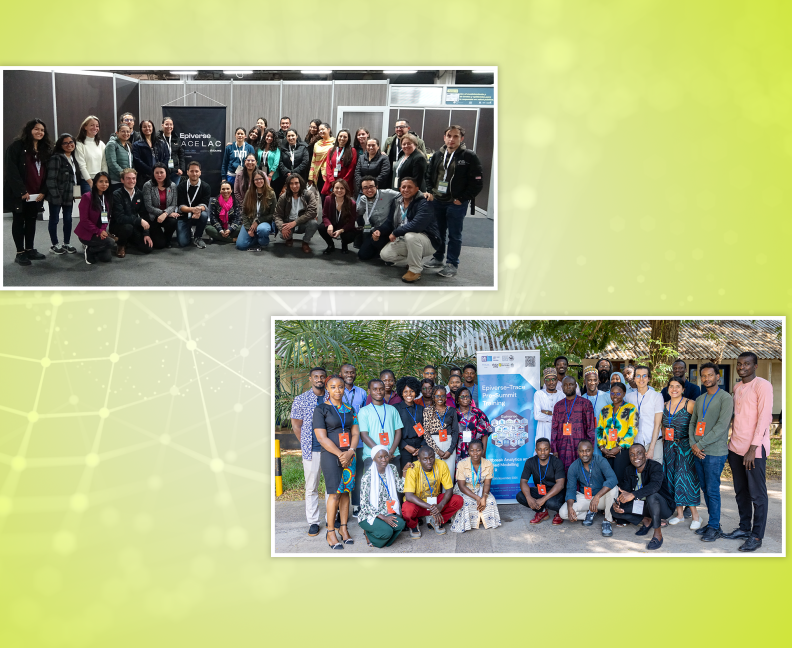
This playbook exists thanks to a remarkable community. The Rockefeller Foundation made the work possible as a funder, and data.org is proud to publish it. Our academic partners—Universidad Javeriana, the London School of Hygiene & Tropical Medicine (LSHTM), and the Medical Research Council Unit The Gambia (MRCG)—brought the rigor and real-world insight that shaped every page. And to the wider Epiverse community of developers and fellows who generously shared their time and expertise in our interviews: thank you.
Explore this playbook
This playbook helps builders design ethically grounded data systems, funders align investments with the ethical, institutional, and technical dimensions needed for sustainable impact, and partners recognize how collaborative ecosystems drive trustworthy, equitable, and scalable data solutions in global health.
01
Introduction
Frames Epiverse as a case study in why ethics must be built into the architecture of global health data systems, not bolted on as an afterthought.
Read more
02
Methodology
Explains how the playbook's findings come from semi-structured interviews with 18 stakeholders across the Epiverse ecosystem, capturing how ethics operates in practice rather than on paper.
Read more
Introduces the six principles (Inclusivity, Data Community, Human Data Security, Safe Data, Data-Enabled Human Flourishing, and Data Accountability) that anchor Epiverse's ethical framework.
Read more
Unpacks the three principles that keep data systems safe and trustworthy—Human Data Security, Safe Data, and Data Accountability—showing how they work together as a layered system of safeguards rather than isolated compliance checks.
Read more
Argues that participation must move beyond token representation toward real influence over how data systems are shaped and governed.
Read more
Asks what data systems are ultimately for, centering the principle of Data-Enabled Human Flourishing as the measure of success beyond technical performance.
Read more
Translates the Protection layer into concrete indicators, maturity signals, and a governance framework organizations can use to self-assess.
Read more
Does the same operational work for the Participation layer, turning Inclusivity and Data Community into measurable indicators and shared-governance practices.
Read more
Operationalizes Data-Enabled Human Flourishing with indicators, maturity signals, and a theory of change connecting data systems to long-term societal impact.
Read more
Synthesizes the three layers of ethical principles (protection, participation, purpose) into a single integrated methodology that can be used to build resilient data ecosystems and suggests governance as a key area of future focus for programs like Epiverse.
Read more