Audience

- Builders: Reflect on how ethical principles can guide the long-term design and governance of data systems.
- Funders: Consider how sustainable investment strategies can strengthen responsible and equitable innovation.
- Partners: Identify opportunities for continued collaboration, shared learning, and collective governance.
Overview
As data systems become increasingly central to global health decision-making, the challenge is no longer only technical. The future of data ecosystems depends on their capacity to remain trustworthy, inclusive, and aligned with meaningful societal outcomes.
This playbook has explored how ethical principles can move beyond abstract commitments and become operational components of real-world systems. Through the Epiverse ecosystem, the framework presented here demonstrates that responsible data governance is not achieved through isolated interventions, but through the interaction of multiple layers of protection, participation, and purpose.
Together, these layers provide a structured approach for understanding how ethical responsibility can be embedded across technical infrastructures, institutional arrangements, and collaborative networks.
Responsible data systems are not defined only by what they can do, but by how they shape relationships, trust, and collective futures.
Project perspective
From Principles to Practice
A central insight emerging from this work is that ethical governance cannot rely solely on individual responsibility or institutional intention. Sustainable systems require operational mechanisms that support:
- protection and accountability
- meaningful participation and collaboration
- alignment with long-term human and societal outcomes
The indicators, governance approaches, and practical examples presented throughout this playbook illustrate how ethical principles can be translated into implementable practices across diverse contexts.
At the same time, the research highlights that there is no single universal model for responsible data governance. Effective systems remain adaptive, context-sensitive, and responsive to evolving public health conditions and institutional realities.
Epiverse: Overall Assessment Across the Three Layers
Bringing together the worked examples from Chapters 7–9, Epiverse scores in the middle-to-upper range on each layer’s own maturity ladder—solidly established, but with one clear structural gap in each:
| Layer | Average Score | Maturity Level | Lowest-Scoring Indicator |
|---|---|---|---|
| Protection | 3.7 / 5 | Structured | Governance clarity (2/5) — responsibility described as an informal expectation, not a documented structure. |
| Participation | 3.7 / 5 | Collaborative | Influence / Collaborative governance (2/5) — inclusion in design has not yet translated into shared agenda-setting authority. |
| Purpose | 3.4 / 5 | Institutionally Aligned | Long-term sustainability planning (2/5) — no documented financial or institutional strategy beyond individual partnership agreements. |
A convergent pattern: the lowest-scoring indicator in each layer is not a technical gap—it is a governance gap. Protection, Participation, and Purpose each reach their weakest point around the same underlying issue: the absence of a formally documented structure for shared decision-making authority and long-term institutional commitment. Epiverse’s technical and procedural safeguards are consistently strong; what remains underdeveloped, across all three layers, is who holds authority over decisions once the initial design phase is complete. This is arguably the single highest-leverage priority for future strategic investment.
Key Lessons from the Playbook

- Protection requires layered governance
Trust depends on safeguards that combine technical, institutional, and procedural mechanisms - Participation must move beyond representation
Sustainable systems require meaningful engagement, collaboration, and shared responsibility - Purpose should guide implementation
Data systems create value when they contribute to long-term human and societal well-being - Ethics is operational, not abstract
Responsible governance depends on implementation practices, not principles alone
Building Resilient Ecosystems
The findings from the Epiverse ecosystem suggest a broader transformation in how data systems are understood. Increasingly, these systems are not viewed simply as technical infrastructures, but as socio-technical ecosystems shaped by governance, relationships, institutions, and communities.
This shift carries important implications:
- collaboration becomes essential rather than optional
- governance becomes continuous rather than static
- trust becomes a core operational condition rather than an external outcome
Building resilient ecosystems therefore requires long-term investment not only in technology, but also in coordination, capacity-building, and shared governance structures.
Future Directions
As global health systems continue to evolve, new ethical and operational challenges will emerge:
- cross-border data governance
- AI-assisted decision-making
- unequal technical capacities across regions
- sustainability beyond short-term funding cycles
The framework presented in this playbook is not intended as a fixed solution. Rather, it provides a flexible foundation that organizations, institutions, and communities can adapt to their own contexts and priorities.
A Collective Responsibility
Ultimately, responsible data systems depend on collective effort. Builders, funders, researchers, institutions, and communities all play a role in shaping how data is governed, shared, and used.
The future of ethical data ecosystems will depend not only on technological innovation, but also on the ability to sustain trust, accountability, participation, and human-centered purpose across increasingly interconnected environments.
From ethical framework to governance practice
A central contribution of this playbook lies in its attempt to bridge ethical principles with operational governance practices across complex public health ecosystems.
The findings from the Epiverse ecosystem suggest that responsible data systems cannot rely solely on technical safeguards or institutional intentions. Sustainable governance requires coordinated mechanisms capable of integrating:
- protection,
- participation,
- and purpose across technical, organizational, and collaborative environments.
Within this framework:
- protection strengthens trust and operational reliability,
- participation strengthens legitimacy and collaborative resilience,
- and purpose aligns systems with long-term societal outcomes.
Together, these layers support a broader transition:
from fragmented governance practices toward integrated socio-technical stewardship.
Importantly, the framework presented throughout this playbook is not intended as a rigid governance model. Instead, it functions as an adaptable structure that organizations may interpret and operationalize according to contextual conditions, institutional capacities, and evolving public health priorities.
Translating Principles into Operational Governance
| Ethical Layer | Governance Objective | Operational Translation |
|---|---|---|
| Protection | Ensure trustworthy and secure systems | Risk management, accountability, safeguards, governance oversight |
| Participation | Enable inclusive and collaborative ecosystems | Co-creation, representation, shared governance structures |
| Purpose | Align systems with long-term societal value | Sustainability planning, contextual adaptation, public-value orientation |
The framework therefore supports a governance approach in which ethics is not external to implementation, but embedded within institutional coordination, operational decision-making, and long-term system development.
Adaptive Governance and Continuous Learning
The research findings indicate that ethical governance within collaborative data ecosystems cannot remain static. As systems evolve across technological, institutional, and geopolitical environments, governance mechanisms must also adapt to emerging risks, changing public health conditions, and shifting stakeholder expectations.
Effective governance therefore depends not only on predefined safeguards, but also on continuous institutional learning.
This requires organizations to:
- periodically reassess governance practices,
- review participation and accountability structures,
- adapt safeguards to contextual conditions,
- and integrate lessons from operational experience over time.
The findings suggest that resilient ecosystems emerge when governance is treated as an ongoing process of coordination, reflection, and institutional adaptation rather than as a fixed compliance framework.
Ethical Governance Integration Cycle
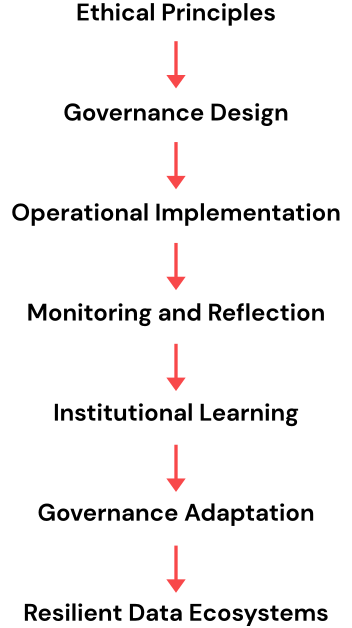
This cycle illustrates how ethical governance becomes embedded through continuous interaction between principles, implementation practices, institutional learning, and adaptive coordination.
The findings suggest that long-term resilience depends not only on technical capability, but also on the ability of institutions and communities to continuously negotiate, evaluate, and strengthen governance practices over time.
Institutional Pathways for Implementation
Organizations seeking to operationalize the framework presented in this playbook may adopt different implementation pathways depending on institutional maturity, governance capacity, and contextual conditions. Rather than prescribing a single implementation model, the framework supports gradual and adaptive integration across multiple dimensions.
Implementation pathways may include:
- strengthening existing governance mechanisms,
- integrating participation structures into decision-making,
- developing long-term sustainability strategies,
- improving institutional coordination,
- and embedding ethical review practices into operational workflows.
Importantly, implementation should remain proportional to organizational capacity and responsive to evolving governance environments.
Strategic Implementation Priorities
| Implementation Priority | Governance Focus | Example Actions |
|---|---|---|
| Governance Foundations | Establishing accountability and safeguards | Risk assessments, governance reviews, documentation protocols |
| Participatory Capacity | Strengthening collaboration and inclusion | Co-creation forums, mentorship, multilingual resources |
| Institutional Coordination | Supporting long-term operational integration | Cross-institutional governance structures |
| Sustainability Planning | Ensuring continuity beyond short-term funding | Long-term partnerships and institutional adoption |
| Adaptive Evaluation | Supporting continuous governance learning | Periodic reviews, maturity assessments, governance reflection cycles |
The Epiverse experience demonstrates that ethical governance is not separate from innovation. It is a condition for sustainable and meaningful innovation. By embedding protection, participation, and purpose into operational practice, data systems can contribute not only to stronger infrastructures, but also to more equitable, collaborative, and resilient futures.
Final Strategic Reflection
Responsible data ecosystems are not built solely through technological innovation. They emerge through sustained coordination between governance structures, institutional relationships, technical infrastructures, and collaborative communities.
The Epiverse experience demonstrates that ethical principles become operationally meaningful when they are embedded within continuous governance practices capable of adapting to evolving societal, institutional, and public health conditions.
As global health ecosystems become increasingly interconnected, the long-term sustainability of data systems will depend not only on their technical performance, but also on their capacity to sustain:
- trust,
- accountability,
- participation,
- contextual responsiveness,
- and human-centered public value.
The framework presented in this playbook therefore represents not a fixed solution, but a foundation for ongoing collective governance, institutional learning, and resilient socio-technical collaboration.