Audience

- Builders: Learn how to align data systems with meaningful human and societal outcomes.
- Funders: Understand how long-term impact can be assessed beyond technical performance indicators.
- Partners: Recognize how shared purpose supports coordination, sustainability, and equitable impact across ecosystems.
Overview
Purpose principles become meaningful when data systems contribute not only to technical outputs, but to broader improvements in human well-being, equity, and societal resilience. While protection and participation shape how systems operate, purpose defines why they exist and how success should ultimately be understood.
Within Epiverse, the purpose layer is operationalized through the principle of .
Data systems create value not only through information, but through their capacity to support equitable and sustainable human outcomes.
Project perspective
Why Purpose Matters in Practice
In many data initiatives, success is measured through operational outputs:
- datasets generated
- models developed
- platforms deployed
- users reached
While these indicators remain important, they do not necessarily capture whether systems contribute to improved decision-making, stronger institutions, or better conditions for communities.
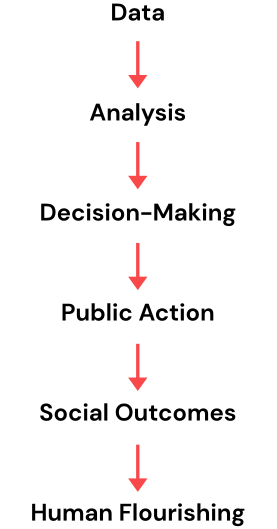
Operationalizing purpose therefore requires linking technical processes to broader forms of public value and long-term societal benefit.
Flow diagram: Operationalizing Purpose
Purpose Indicators in Practice
The indicators below illustrate how organizations may assess whether systems contribute to meaningful and sustainable outcomes beyond technical functionality alone.
🟢 Established
Systems demonstrate clear alignment between technical activities and long-term societal outcomes
🟡 Emerging
Impact-oriented practices exist but remain uneven or inconsistently integrated
🔴 Limited
Systems prioritize short-term outputs without broader mechanisms for evaluating societal impact
Table: Purpose Indicators, Metrics, and Maturity Signals
| Principle | Operational Indicator | Example Metric | Maturity Signal |
| Data-Enabled Human Flourishing | Alignment between system outputs and public needs | Presence of outcome-oriented project objectives | 🟢 / 🟡 / 🔴 |
| Data-Enabled Human Flourishing | Evidence-informed decision-making | Number of policies, interventions, or actions informed by system outputs | 🟢 / 🟡 / 🔴 |
| Data-Enabled Human Flourishing | Equity and contextual responsiveness | Inclusion of locally defined priorities and needs assessments | 🟢 / 🟡 / 🔴 |
| Data-Enabled Human Flourishing | Long-term sustainability planning | Presence of continuity strategies beyond initial funding cycles | 🟢 / 🟡 / 🔴 |
| Data-Enabled Human Flourishing | Capacity and institutional strengthening | Number of long-term partnerships, training initiatives, or institutional collaborations supported | 🟢 / 🟡 / 🔴 |
Epiverse Evidence: What these Indicators Look Like in Practice
Applying the scale above to Epiverse itself, drawing on both interview rounds. 18 stakeholders across the wider ecosystem, and 7 core team leads spanning technical, program, and community-building roles:
| Indicator | Epiverse Maturity Signal | Evidence from Interviews |
|---|---|---|
| Alignment between system outputs and public needs | 🟢 | A concrete case showed data-analysis time reduced from roughly a month to a few hours, allowing local health authorities to make faster decisions; a separate training case fed directly into sub-national climate and health policy design. |
| Evidence-informed decision-making | 🟢 | Government forecasting during epidemics and the analysis-time reduction case both show outputs directly informing real decisions, not only producing dashboards or reports. |
| Equity and contextual responsiveness | 🟡 | Explicit gender-inclusion targets (roughly 40–55% women in trainings) are consistently met, and programs are co-designed with local partners; team leads nonetheless described this principle as still aspirational, more often implied than systematically operationalized. |
| Long-term sustainability planning | 🟡 | Program renewal phases are shaped collaboratively with partners rather than imposed top-down, suggesting some forward planning; but no interviewee described a documented long-term financial or institutional sustainability strategy beyond individual partnership agreements. |
| Capacity and institutional strengthening | 🟢 | Sustained, large-scale training pipelines, including fellowships, civil-servant training, and university partnerships, indicate durable capability transfer rather than one-off outputs. |
Overall assessment across both interview rounds: Purpose is strongest where outcomes are directly observable (faster decisions, trained capacity) and weakest where it depends on long-horizon, systemic change (equity at scale, sustainability planning)—both of which several interviewees explicitly described as aspirational rather than yet operationalized.
Evidence from Stakeholder Interviews
The interview analysis revealed that stakeholders consistently framed purpose in terms of long-term public value rather than technical achievement alone. Participants emphasized that the success of data systems depends on their capacity to improve decision-making, strengthen collaboration, and contribute to equitable outcomes across contexts.
Several recurring themes emerged:
- Impact beyond technical outputs
Stakeholders emphasized that datasets and tools should support meaningful institutional and societal outcomes rather than functioning as isolated technical products. - Equity and contextual relevance
Multiple participants highlighted the importance of adapting systems to local priorities, capacities, and public health realities. - Sustainability and long-term value
Interviewees repeatedly emphasized the need for systems that remain functional and collaborative beyond short-term funding cycles. - Human-centered approaches to governance
Several participants described trust, well-being, and social responsibility as essential dimensions of meaningful impact.
The findings suggest a broader shift from viewing data systems primarily as technical infrastructures toward understanding them as socio-technical ecosystems connected to human outcomes and collective well-being.
Table: Cross-group Perspectives on Purpose
| Stakeholder Emphasis | Main Concern | Purpose Focus |
|---|---|---|
| Technical contributors | Functional performance and usability | Effective tools supporting action |
| Governance actors | Institutional coordination and sustainability | Long-term public value |
| Community and regional actors | Equity and contextual relevance | Human-centered outcomes and trust |
Derived from cross-group interview analysis
Warning signs: When purpose mechanisms are weak

- Success is measured only through technical outputs or platform activity
- Systems lack mechanisms for evaluating long-term societal impact
- Local priorities and contextual needs are excluded from planning processes
- Projects depend entirely on short-term funding cycles without sustainability planning
- Technical performance is prioritized over human-centered outcomes and equity considerations
Voices from Epiverse: Purpose in Practice

- Measurable outcomes: A Fellow working in HIV care linked flourishing directly to patient monitoring. When data lets health workers track patients and prevent loss to follow-up, the principle stops being abstract and becomes a number of people who stayed in care.
- Building capability, not just delivering outputs: A Fellow argued that flourishing is not merely receiving improved services; it is about developing the capacity to shape responses according to local priorities.
- Structural equity: A Fellow from West Africa warned that global data infrastructures often replicate existing asymmetries rather than correct them. In this view, meaningful flourishing requires redistributing epistemic authority and regional leadership, not just delivering better tools.
Common Implementation Challenges
Operationalizing purpose often requires balancing competing priorities across institutions, timelines, and governance environments.
Key challenges include:
- measuring long-term societal outcomes within short project cycles
- balancing standardized indicators with local contextual needs
- maintaining sustainability after initial funding periods
- translating technical outputs into policy or public health action
The research suggests that meaningful impact depends not only on technological capability, but also on institutional coordination, governance alignment, and ongoing community engagement.
Practical Solutions and Strategies
Organizations can strengthen purpose-oriented implementation through:
- integrating outcome-oriented evaluation frameworks
- aligning technical objectives with public health priorities
- incorporating local stakeholders into planning and assessment processes
- supporting long-term institutional partnerships and capacity-building
- developing sustainability strategies from the outset of projects
Importantly, systems should remain adaptive and responsive to evolving societal conditions rather than relying solely on fixed performance metrics.
Practice highlight

Within Epiverse, purpose first becomes tangible through epidemic preparedness, the domain for which the community was originally created. Faster detection and better-informed modeling translate directly into earlier interventions during outbreaks, making the value of data-informed collaboration visible in real-world public health responses. The same community, tools, and governance approach have since been extended to other fields, including HIV care. In this case, data-informed monitoring enables health workers to track patients and reduce loss to follow-up. Together, these examples demonstrate not only the realization of the flourishing principle in measurable health outcomes, but also the versatility and adaptability of the Epiverse ecosystem across different public health contexts.
Purpose and Impact Governance Framework
Purpose-oriented governance requires organizations to evaluate not only whether systems function effectively, but whether they contribute to meaningful and sustainable societal outcomes over time.
Within complex public health ecosystems, impact rarely emerges through direct linear processes alone. Instead, societal outcomes are shaped through the interaction of:
- technical systems,
- institutional coordination,
- governance structures,
- contextual adaptation,
- and collaborative relationships.
To support this process, organizations may adopt a purpose and impact governance framework that evaluates how data systems align with long-term human, institutional, and societal priorities.
Rather than functioning as a narrow performance-evaluation mechanism, the framework supports:
- alignment between technical activities and public value,
- institutional sustainability,
- context-sensitive implementation,
- and adaptive long-term governance.
Importantly, purpose should not be interpreted as a fixed or universal outcome. Different institutions and communities may define meaningful impact differently depending on local priorities, governance environments, and public health conditions.
Purpose Maturity Framework
| Maturity Level | Purpose Characteristics | Operational Signals |
|---|---|---|
| Level 1 Output-Oriented | Systems focus primarily on technical delivery and operational outputs | Activity-based reporting, limited societal evaluation |
| Level 2 Outcome-Aware | Organizations begin linking technical outputs to operational outcomes | Initial impact discussions, emerging evaluation practices |
| Level 3 Institutionally Aligned | Systems integrate governance, coordination, and contextual objectives | Outcome-oriented planning, institutional collaboration |
| Level 4 Public-Value Integrated | Data activities are aligned with long-term societal and public health priorities | Sustainability planning, contextual adaptation, governance integration |
| Level 5 Human-Centered Ecosystem | Systems continuously adapt to support equitable, sustainable, and human-centered outcomes | Institutional resilience, collaborative stewardship, adaptive governance culture |
This framework allows organizations to evaluate purpose not only through technical performance indicators, but through alignment with institutional continuity, contextual relevance, and broader societal benefit.
The interview findings suggest that sustainable impact depends on the ability of systems to remain adaptive, collaborative, and responsive across changing governance and public health environments.
Theory of Change and Impact Pathways
The research findings indicate that meaningful societal impact emerges through interconnected processes rather than isolated technical interventions.
Within collaborative public health ecosystems, data systems contribute to impact through multiple stages of transformation:
- data generation,
- analysis and interpretation,
- governance coordination,
- institutional decision-making,
- and public action.
The relationship between these stages is neither automatic nor guaranteed. Effective impact therefore depends on governance structures capable of connecting technical outputs with institutional responsiveness and contextual implementation.
Socio-technical Impact Pathway
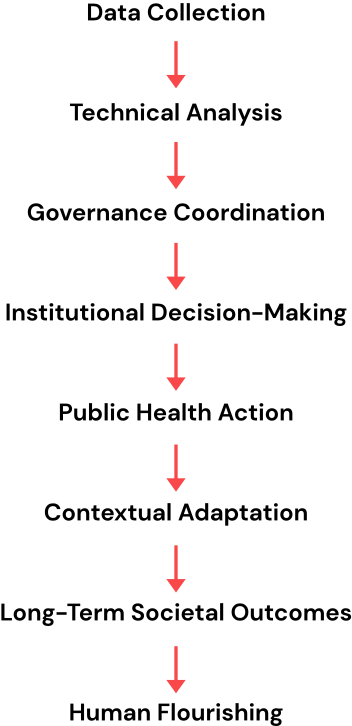
This pathway illustrates how societal impact depends not only on technical capability, but also on governance alignment, institutional coordination, and ongoing contextual responsiveness.
The findings suggest that systems become more resilient when organizations evaluate not only outputs, but also how technical processes contribute to institutional learning, collaborative capacity, and long-term public value.
Outcome Dimensions and Evaluation Focus
| Outcome Dimension | Evaluation Focus | Example Operational Indicators | Epiverse Example |
|---|---|---|---|
| Institutional Capacity | Strengthening governance and operational coordination | Long-term partnerships, governance continuity | Sustained training pipelines, fellowships, civil-servant training, and university partnerships point to durable capability transfer rather than one-off outputs. (Likert 4/5) |
| Public Health Responsiveness | Ability to support timely and context-sensitive action | Evidence-informed interventions and planning | Government forecasting during epidemics and a case-reducing analysis time from a month to hours both show outputs directly informing real decisions. (Likert 4/5) |
| Equity and Inclusion | Alignment with local priorities and contextual realities | Inclusion of regional needs and participation structures | Gender-inclusion targets (roughly 40–55% women) are consistently met, yet team leads describe systemic equity as still aspirational rather than fully operationalized. (Likert 3/5) |
| Sustainability | Long-term operational continuity beyond funding cycles | Continuity strategies and institutional adoption | Program renewal is shaped collaboratively with partners, but no documented long-term financial or institutional sustainability strategy was identified. (Likert 2/5) |
| Collaborative Resilience | Stability of multi-actor coordination over time | Recurring governance forums and collaborative mechanisms | Multi-year, co-designed partnership renewal cycles suggest durable multi-actor coordination, though scaling engagement beyond current partners remains a recognized limit. |
Sustainability and Institutional Continuity
The interview findings consistently emphasized that meaningful impact depends on long-term institutional continuity rather than isolated project outcomes.
Within collaborative ecosystems, sustainability involves more than maintaining technical infrastructure. It also requires:
- stable governance structures,
- institutional coordination,
- knowledge continuity,
- capacity-building,
- and sustained collaborative engagement.
Organizations may therefore evaluate sustainability not only through financial continuity, but also through the ability of systems to remain operationally relevant, institutionally supported, and contextually adaptable over time.
Sustainability Assessment Dimensions
| Sustainability Dimension | Assessment Focus | Example Evidence Sources |
|---|---|---|
| Governance Continuity | Stability of oversight and coordination mechanisms | Governance structures and review processes |
| Institutional Adoption | Integration into organizational workflows | Policy integration and operational procedures |
| Capacity Retention | Long-term development of local expertise | Training continuity and mentorship structures |
| Partnership Stability | Sustained collaborative engagement | Long-term institutional partnerships |
| Adaptive Responsiveness | Ability to evolve across changing conditions | Governance revisions and contextual adaptation |
Self-Assessment Scale
To move from the qualitative maturity signals above to a practical self-assessment, organizations can score each indicator on a 1–5 scale. The Epiverse examples referenced earlier in this chapter illustrate what a high score looks like in practice—they serve as a benchmark, not as items to be scored themselves.
Likert scale key: 1 = Output-Oriented • 2 = Outcome-Aware • 3 = Institutionally Aligned • 4 = Public-Value Integrated • 5 = Human-Centered Ecosystem
Scoring guide (average across items):
• 1.0–1.9 → Output-Oriented • 2.0–2.9 → Outcome-Aware • 3.0–3.9 → Institutionally Aligned • 4.0–4.5 → Public-Value Integrated • 4.6–5.0 → Human-Centered Ecosystem
Having seen where Epiverse stands qualitatively earlier in this chapter, the same evaluation can now be expressed numerically below, using the Likert scale introduced above.
Epiverse Example Scoring: Purpose Indicators
Using the Likert scale key above, each indicator can be scored individually and verified against a specific evidence basis—the same logic used in the Evidence sources and verification methods table, applied here to Epiverse’s own results.
| Operational Dimension | Epiverse Likert Score (1–5) | Verification Basis (Interview Evidence) |
|---|---|---|
| Alignment between system outputs and public needs | 4 | Impact assessment: concrete cases confirmed (analysis time reduced from a month to hours; training informing sub-national policy), though not yet systematized across all use cases. |
| Evidence-informed decision-making | 4 | Outcome verification: government forecasting during epidemics and rapid-decision cases confirmed as direct, documented uses of Epiverse outputs. |
| Equity and contextual responsiveness | 3 | Program review: gender-inclusion targets (40–55% women) consistently met and confirmed; team leads themselves describe systemic equity as still aspirational. |
| Long-term sustainability planning | 2 | Institutional review: collaborative program renewal confirmed, but no documented long-term financial or institutional sustainability strategy identified beyond individual partnership agreements. |
| Capacity and institutional strengthening | 4 | Outcome verification: sustained training pipelines (fellowships, civil-servant training, university partnerships) confirmed as producing durable capability transfer. |
Average score: 3.4 / 5 → Institutionally Aligned. Purpose is strongest where outcomes are directly observable; long-term sustainability planning is the clearest gap toward becoming a fully Public-Value Integrated, Human-Centered Ecosystem.
Risks of Impact Reductionism
A recurring challenge within impact-oriented governance concerns the tendency to reduce complex societal outcomes to simplified quantitative indicators.
While operational metrics remain important, the research findings suggest that many dimensions of human flourishing, including trust, contextual relevance, collaborative legitimacy, and institutional resilience, cannot be fully captured through numerical measurement alone.
Overreliance on narrow performance indicators may therefore:
- prioritize short-term outputs over long-term societal value,
- overlook contextual differences across regions and institutions,
- and obscure relational dimensions of governance and collaboration.
Effective impact evaluation consequently requires combining operational indicators with qualitative assessment, contextual interpretation, and ongoing stakeholder engagement.
The findings suggest that meaningful purpose-oriented governance depends not only on measuring activity, but also on continuously reflecting on how systems shape institutional relationships, public trust, and collective well-being over time.
From Outputs to Flourishing
Purpose-oriented systems recognize that technical performance alone is insufficient to define success. Sustainable impact emerges when systems contribute to trust, institutional resilience, equitable access, and improved human conditions over time.
Operationalizing human flourishing therefore requires continuous reflection on how systems shape relationships, opportunities, and collective well-being across contexts.