Audience

- Builders: Learn how to design participatory systems that move beyond representation toward meaningful collaboration.
- Funders: Understand how inclusive governance and community participation strengthen sustainability and long-term impact.
- Partners: Identify practices that support shared ownership, collaboration, and trust across institutions and communities.
Overview
Participation principles become meaningful when individuals and communities are not only included within systems, but are able to influence how those systems operate. In practice, this requires moving beyond symbolic inclusion toward structures that enable engagement, collaboration, and shared governance.
Within Epiverse, participation is operationalized through two interconnected principles:
- Inclusivity
- Data Community
Together, these principles shape how actors enter, contribute to, and help sustain data ecosystems over time.
Participation is not simply about access to systems. It is about the ability to shape decisions, contribute knowledge, and build shared responsibility.
Project perspective
Why Participation Matters in Practice
Data systems operating across global health environments depend on diverse forms of expertise, contextual understanding, and institutional coordination. Without participation mechanisms, systems risk reproducing exclusion, concentrating authority, and limiting long-term adoption.
Effective participation strengthens:
- legitimacy and trust
- local relevance and contextual responsiveness
- collaboration across institutions and regions
- sustainability beyond individual projects or funding cycles
Participation therefore functions not only as an ethical principle, but as a practical condition for resilient and adaptive systems.
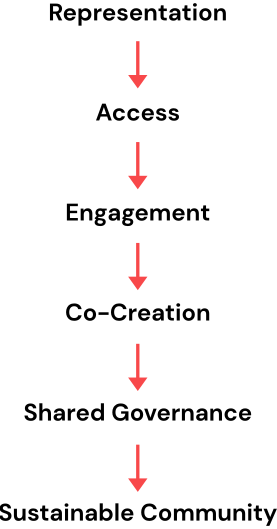
Flow Diagram: Operationalizing Participation
Participation Indicators in Practice
The indicators below illustrate how participation principles can be translated into operational practices and governance structures.
🟢 Established
Mechanisms are formally implemented, consistently applied, and regularly reviewed
🟡 Emerging
Mechanisms exist partially or inconsistently across projects or institutions
🔴 Limited
Significant gaps remain in implementation, oversight, or operational consistency
Table: Participation Indicators, Metrics, and Maturity Signals
| Principle | Operational Indicator | Example Metric | Maturity Signal |
|---|---|---|---|
| Inclusivity | Diversity of stakeholder participation | Representation of actors across regions, disciplines, and institutional levels | 🟢 / 🟡 / 🔴 |
| Inclusivity | Accessibility of tools and processes | Availability of multilingual resources and open-access materials | 🟢 / 🟡 / 🔴 |
| Inclusivity | Capacity-building opportunities | Number of training or mentorship activities conducted annually | 🟢 / 🟡 / 🔴 |
| Data Community | Collaborative governance practices | Presence of shared decision-making structures | 🟢 / 🟡 / 🔴 |
| Data Community | Knowledge-sharing mechanisms | Frequency of community workshops or collaborative exchanges | 🟢 / 🟡 / 🔴 |
| Data Community | Sustained institutional engagement | Number of active institutional partnerships over time | 🟢 / 🟡 / 🔴 |
Epiverse Evidence: What these Indicators Look Like in Practice
Applying the scale above to Epiverse itself, drawing on both interview rounds—18 stakeholders across the wider ecosystem, and 7 core team leads spanning technical, program, and community-building roles:
| Indicator | Epiverse Maturity Signal | Evidence from Interviews |
|---|---|---|
| Diversity of stakeholder participation | 🟢 | The fellowship network spans multiple African countries and roles, and core team leadership itself spans technical, community-building, and capacity-building functions across regions. |
| Accessibility of tools and processes | 🟡 | Multilingual training materials (English, French, Spanish, with translation into additional languages underway), open-source development, and domain-specific language design demonstrate strong technical accessibility; however, fellows in lower-resource contexts still flagged infrastructure requirements as a persistent barrier. |
| Capacity-building opportunities | 🟢 | Large-scale training programs (hundreds of participants in regional courses, tens of thousands of civil servants trained) and a dedicated capacity-building leadership function confirm this as a core, resourced activity rather than an occasional effort. |
| Collaborative governance practices | 🟡 | Program phases are co-designed with academic, governmental, and local partners, yet a regional researcher noted that inclusion in a dataset is not the same as influence over agenda-setting (participation in design has not yet fully translated into shared decision-making authority). |
| Knowledge-sharing mechanisms | 🟢 | Regular partner calls, international conference participation, newsletters, and open-access training materials were each confirmed independently by multiple team leads as active, ongoing practices. |
| Sustained institutional engagement | 🟢 | Multi-year partnerships with ministries of health, universities, and international research institutions demonstrate engagement that persists across program phases rather than ending with individual projects. |
Overall assessment across both interview rounds: Participation is well established within existing, institutionally-anchored networks. The consistent gap is outreach beyond current partners. Each interview round independently raised the same tension between strong engagement within known networks and limited expansion toward new or non-traditional stakeholders.
Evidence from Stakeholder Interviews
The interview analysis revealed that participation within the Epiverse ecosystem extends beyond simple representation. Stakeholders consistently emphasized the importance of meaningful engagement, collaborative learning, and shared responsibility across institutions and communities.
Several recurring themes emerged:
- Participation as influence rather than presence
Interviewees emphasized that inclusion becomes meaningful only when participants are able to contribute to decision-making processes and shape system development. - Knowledge diversity and epistemic inclusion
Multiple stakeholders highlighted the importance of recognizing different forms of expertise, including local and contextual knowledge. - Capacity-building as an enabling condition
Training, mentorship, and collaborative learning were repeatedly identified as essential for supporting sustained participation across regions and institutions. - Trust as a foundation for collaboration
Participants emphasized that long-term collaboration depends on stable relationships, transparency, and shared governance structures.
The findings also suggest a broader shift in how participation is understood. Rather than treating communities as passive recipients of technology, the Epiverse ecosystem increasingly frames participation as a process of co-creation and distributed responsibility.
Table: Cross-Group Perspectives on Participation
Derived from cross-group interview analysis
| Stakeholder Emphasis | Main Concern | Participation Focus |
|---|---|---|
| Technical contributors | Effective collaboration and coordination | Shared tools and collaborative workflows |
| Governance actors | Representation and institutional inclusion | Fair participation and oversight |
| Community and regional actors | Recognition of contextual knowledge | Co-creation and local relevance |
Warning signs: When participation mechanisms are weak

- Stakeholder participation is limited to consultation without decision-making influence
- Participation opportunities are concentrated among a small number of actors or institutions
- Local knowledge and contextual expertise are excluded from governance processes
- Capacity-building opportunities are unevenly distributed
- Collaboration depends on informal relationships without stable coordination structures
Common Implementation Challenges
Operationalizing participation often involves navigating tensions between openness, coordination, and institutional capacity.
Key challenges include:
- balancing broad participation with efficient decision-making
- supporting inclusion across unequal resource environments
- maintaining collaboration across geographically distributed networks
- preventing symbolic participation without real influence
The research suggests that participation becomes sustainable when governance structures combine flexibility with institutional support.
Practical Solutions and Strategies
Organizations can strengthen participation through:
- structured co-creation processes
- transparent governance mechanisms
- long-term mentorship and training programs
- multilingual and accessible resources
- regular community exchanges and collaborative forums
Importantly, participation mechanisms should remain adaptive to local contexts and institutional realities rather than relying on rigid universal models.
Voices from Epiverse: Participation in Practice

- On accessibility: A Fellow reflecting on tool design noted that systems requiring advanced infrastructure risk excluding the very actors they are meant to support. Therefore, accessibility in this view, is not a technical afterthought but a condition for participation itself.
- On epistemic authority: A regional researcher raised a sharper question: inclusion in a dataset is not the same as influence over what counts as valid knowledge or which problems get prioritized. Genuine participation, in this framing, requires a voice in setting the agenda and not just visibility within it.
- On reciprocity: A Fellow from West Africa cautioned that global data infrastructures can quietly replicate existing asymmetries if data flows mainly toward centralized actors without equitable return. Trust, in this account, depends on whether collaboration produces mutual benefit and not just technical interoperability.
Participation Maturity Framework
Participation within data ecosystems cannot be evaluated solely through presence or representation. Meaningful participation depends on the degree to which individuals, communities, and institutions are able to influence governance processes, contribute contextual knowledge, and shape system development over time.
In order to support this process, organizations may adopt a participation maturity framework that evaluates how collaborative practices evolve from limited consultation toward shared governance and distributed responsibility.
Rather than functioning as a fixed compliance mechanism, the framework provides a structured approach for:
- identifying participation gaps,
- strengthening governance legitimacy,
- supporting inclusive collaboration,
- and improving long-term institutional resilience.
The maturity model reflects the transition from participation as access toward participation as influence, co-creation, and collective stewardship.
Importantly, participation maturity may vary across institutional settings, governance structures, and regional contexts. As a result, assessment should support reflection and adaptation rather than standardized classification.
Participation Governance Maturity Scale
| Maturity Level | Participation Characteristics | Operational Signals |
|---|---|---|
| Level 1 Informational | Participation is limited to information sharing or passive representation | One-directional communication, minimal stakeholder engagement |
| Level 2 Consultative | Stakeholders are consulted but have limited influence on decisions | Feedback mechanisms exist but remain non-binding |
| Level 3 Collaborative | Participation is integrated into selected governance and operational processes | Regular consultation structures, collaborative activities, working groups |
| Level 4 Co-Creative | Stakeholders actively contribute to system design, governance, and implementation | Shared planning processes, distributed coordination, collaborative decision-making |
| Level 5 Shared Governance | Participation is institutionalized through long-term collaborative governance structures | Co-governance mechanisms, sustained institutional partnerships, distributed responsibility |
This maturity framework enables organizations to evaluate participation not only through numerical representation, but through governance influence, collaboration quality, and institutional integration.
The framework also supports:
- institutional self-assessment,
- governance improvement planning,
- collaboration mapping,
- and capacity-building prioritization.
The interview findings suggest that sustainable participation emerges when systems combine openness with structured governance support capable of maintaining long-term collaboration across distributed actors and institutions.
Dimensions of Meaningful Participation
The research findings indicate that participation operates across multiple interconnected dimensions. Effective participation therefore depends not only on access, but also on the quality, continuity, and influence of engagement processes.
Organizations may evaluate participation across the following dimensions:
- representation,
- accessibility,
- influence,
- collaboration,
- contextual inclusion,
- and institutional continuity.
Together, these dimensions provide a broader understanding of how participation contributes to governance legitimacy and system resilience.
Participation Assessment Dimensions
| Dimension | Assessment Focus | Example Operational Indicators | Epiverse example |
|---|---|---|---|
| Representation | Diversity of participating actors | Regional, institutional, and disciplinary diversity | Fellowship network confirmed across multiple African countries and roles; core team leadership itself spans technical, program, and community-building functions. (Likert 4/5) |
| Accessibility | Ability to participate meaningfully | Multilingual resources, open-access materials, accessibility mechanisms | Multilingual materials and open-source design confirmed; infrastructure barriers in low-resource contexts remain a recurring, unresolved theme. (Likert 3/5) |
| Influence | Degree of participation in decision-making | Participation in governance processes and strategic planning | Program phases are co-designed with partners, but a regional researcher noted inclusion in a dataset is not the same as influence over agenda-setting. (Likert 2/5 — the lowest score in this chapter) |
| Collaboration | Quality of interaction among actors | Working groups, collaborative exchanges, co-development activities | Regular partner calls, conference participation, newsletters, and open-access materials confirmed as active, ongoing practices. (Likert 4/5) |
| Contextual Inclusion | Integration of local knowledge and needs | Inclusion of regional priorities and contextual expertise | Training programs co-designed with local partners across Africa, India, and Southeast Asia, with local actors defining problems and solutions rather than receiving predefined ones. |
| Institutional Continuity | Sustainability of participation structures | Long-term partnerships, recurring forums, governance stability | Multi-year partnerships with ministries of health, universities, and international research institutions confirmed as persisting across program phases. (Likert 4/5) |
These dimensions should not be interpreted as isolated metrics. Their value lies in supporting reflection on how participation is distributed, sustained, and operationalized across governance environments.
The findings suggest that participation becomes more resilient when systems support both formal governance mechanisms and informal relationship-building processes capable of adapting to changing institutional and regional conditions.
Participation Governance Continuum
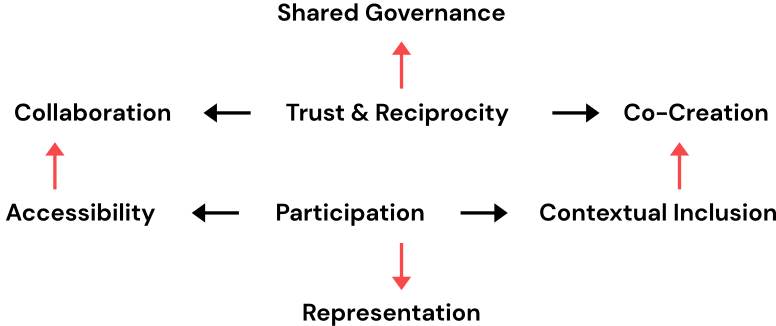
This continuum reflects the progressive evolution of participation within collaborative data ecosystems. Lower levels focus primarily on access and visibility, while higher levels emphasize influence, shared responsibility, and long-term governance integration.
The interview findings suggest that meaningful participation emerges when actors are able not only to contribute knowledge but also to shape governance structures and institutional priorities over time.
Participation Evidence and Verification
Participation mechanisms require not only institutional intention, but also observable governance practices capable of demonstrating continuity, inclusiveness, and collaborative engagement.
Organizations may therefore combine qualitative and operational evidence sources to evaluate how participation principles are implemented in practice.
Importantly, participation assessment should remain sensitive to contextual differences and avoid reducing collaborative dynamics to purely quantitative indicators
Participation evidence sources
| Participation Dimension | Example Evidence Source | Verification Method |
|---|---|---|
| Stakeholder diversity | Participation records and governance documentation | Representation review |
| Accessibility mechanisms | Multilingual materials and training resources | Resource assessment |
| Collaborative governance | Governance meeting records and working-group structures | Institutional review |
| Knowledge-sharing activities | Workshop documentation and collaborative exchanges | Activity tracking |
| Capacity-building | Mentorship and training records | Program evaluation |
| Long-term engagement | Partnership continuity and recurring collaboration structures | Institutional mapping |
Self-Assessment Scale
To move from the qualitative maturity signals above to a practical self-assessment, organizations can score each indicator on a 1–5 scale. The Epiverse examples referenced earlier in this chapter illustrate what a high score looks like in practice. They serve as a benchmark, not as items to be scored themselves.
Likert scale key: 1 = Informational • 2 = Consultative • 3 = Collaborative • 4 = Co-Creative • 5 = Shared Governance
Scoring guide (average across items):
• 1.0–1.9 → Informational • 2.0–2.9 → Consultative • 3.0–3.9 → Collaborative • 4.0–4.5 → Co-Creative • 4.6–5.0 → Shared Governance
Having seen where Epiverse stands qualitatively earlier in this chapter, the same evaluation can now be expressed numerically below, using the Likert scale introduced above.
Epiverse Example Scoring: Participation Indicators
Using the Likert scale key above, each indicator can be scored individually and verified against a specific evidence basis — the same logic used in the Evidence sources and verification methods table, applied here to Epiverse’s own results.
| Operational Dimension | Epiverse Likert Score (1–5) | Verification Basis (Interview Evidence) |
|---|---|---|
| Diversity of stakeholder participation | 4 | Program review: fellowship network confirmed across multiple African countries and roles, spanning technical, program, and community-building functions. |
| Accessibility of tools and processes | 3 | Community engagement review: multilingual materials and open-source design confirmed, but infrastructure barriers in low-resource contexts remain a recurring, unresolved theme. |
| Capacity-building opportunities | 5 | Outcome verification: large-scale training pipelines confirmed (hundreds of regional participants, tens of thousands of civil servants trained) through a dedicated capacity-building leadership function. |
| Collaborative governance practices | 2 | Governance review: co-design of program phases confirmed, but agenda-setting authority explicitly described as not yet shared — inclusion without influence. |
| Knowledge-sharing mechanisms | 4 | Partnership audit: recurring partner calls, conference participation, newsletters, and open-access materials confirmed as active practices by multiple team leads. |
| Sustained institutional engagement | 4 | Institutional review: multi-year partnerships with ministries of health, universities, and research institutions confirmed as persisting across program phases. |
Average score: 3.7 / 5 → Collaborative. Participation is strong within established networks; shared agenda-setting authority — the step toward Co-Creative and Shared Governance — is the clearest gap ahead.
Risks of Symbolic Participation
A recurring challenge within collaborative governance systems concerns the risk of symbolic participation, where inclusion mechanisms exist formally but provide limited influence over decision-making processes. In such contexts, participation may function primarily as representation without meaningful governance integration.
The research findings suggest that symbolic participation often emerges when:
- decision-making authority remains centralized,
- participation opportunities are inconsistent,
- local knowledge is excluded from strategic processes,
- or collaborative structures lack institutional continuity.
Over time, these conditions may weaken trust, reduce long-term engagement, and limit the legitimacy of governance systems. Effective participation therefore requires governance structures capable of translating inclusion into sustained influence, collaborative responsibility, and institutional responsiveness.
From Participation to Collective Resilience
Participation strengthens systems by distributing knowledge, expanding collaboration, and supporting adaptive governance. Over time, these processes contribute to more resilient ecosystems capable of responding to changing public health conditions and institutional needs.
Sustainable participation therefore depends not only on access, but on the continuous development of trust, relationships, and shared responsibility. While participation focuses on who contributes to systems and how collaboration occurs, the next chapter examines how systems translate these efforts into broader societal impact. It explores how purpose principles can be operationalized through indicators, outcomes, and long-term measures of human flourishing.